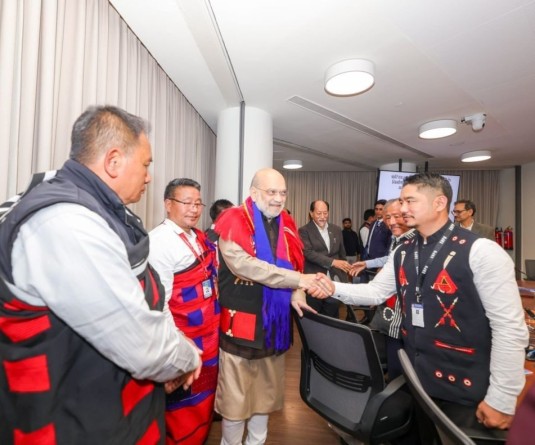
Lotha Hoho adopts resolutions on Assam-Nagaland border issue
Wokha, August 13 (MExN): The Lotha Hoho and all concerned Lotha organizations have welcomed the proposal for settlement of border issue amicably outside the court. While appreciating the Nagaland Legislative Assembly (NLA) for constitution of a 10-member committee to examine the Nagaland- Assam boundary, they agreed to the proposal for settlement of border issue amicably outside the court, by involving local bodies of both sides.
According to a press release from the Chairperson and General Secretary of the Lotha Hoho, the decision was part of several resolutions adopted in a meeting at Wokha on August 11, with regard to the Nagaland – Assam boundary imbroglio.
Rejecting the 1925 British India government notification on Assam-Nagaland boundary, the Hoho noted that when Assam filed a petition in the Supreme Court in 1988, the Survey of India had testified that the 1925 boundary had not been verified by the Survey of India. Also any other maps prepared by the Survey of India on Inter-State Boundary are not acceptable, unless authenticated by the Nagaland government, the Hoho maintained.
Asserting that the Nagaland state was created politically as per terms and provisions of various agreements, the Lotha Hoho said that settlement of boundary must be done outside the court. When there is no officially demarcated boundary, the question of legal arbitration does not arise. “Hence the Lotha Naga tribe demands for setting up of a Boundary Commission for a fair solution to the Nagaland-Assam boundary imbroglio and not in the court,” it added.
The meeting further resolved to stand for the restoration of the ancestral, traditional and historical lands, before final demarcation of Nagaland boundary with Assam.
‘Satellite imaging not practicable’
The Hoho also conveyed the opposition of the Lotha Naga tribe regarding the proposal to ask the Union Home Minister to maintain status quo of boundary, “Since present status does not cover the traditional ancestral lands claimed by the Lotha and other Naga tribes.”
They also opposed the decision of the Government of India (GoI) for demarcation of the inter-state boundaries of the North-Eastern states by use of satellite imaging.
“The satellite imaging is not practicable as the state of Nagaland does not have any clear boundary demarcation on the ground with the state of Assam. Satellite imaging may be used only after physical land marks are established,” the Hoho stated.
On neutral forces
The meeting also resolved to urge the Nagaland government to revoke/abrogate Interim Agreements made with the government of Assam since 1972, stating that the Assam government had “failed to honour” the Agreements and accused the latter of violating the same on many occasions while also “abusing the services of neutral forces.”
The Hoho also called for deployment of neutral forces to be stopped, alleging that they do not exercise fairness, but instead favors the Assam side. It further accused the neutral forces of not allowing implementation GoI and NEC projects within the so called disputed belt whereas those projects “have no boundary within the country/NE region.”
On outposts
The Hoho also urged the Nagaland government to immediately remove the Assam Police out post from Lotha Naga villages of Liphanyan, Chekayan, New Jandalashung, Soshanyan, Lishayan, Rani Pukhri. It urged the government to establish NAP outposts at sensitive areas along Nagaland- Assam boundary within Wokha district, immediately.
The Hoho apprised the Nagaland government that the Naga villagers at the border areas need NAP security protection for building their own houses in their traditional lands, which, it stated, were marked as ‘disputed’ by the Assam police and even the neutral force.
While asking the government to give priority to development works in border areas so as to give support to the Naga people to physically settle and occupy the land, the Hoho also called for upgrading the post of Border Magistrate (BM) to that of Additional Deputy Commissioner. This is so as the BM has to deal with counterparts of other states and hence needs higher status, it reasoned. It also sought for the BM posting to be ‘honourable’ and “not as political punishment posting, as is seemingly being done at present.”