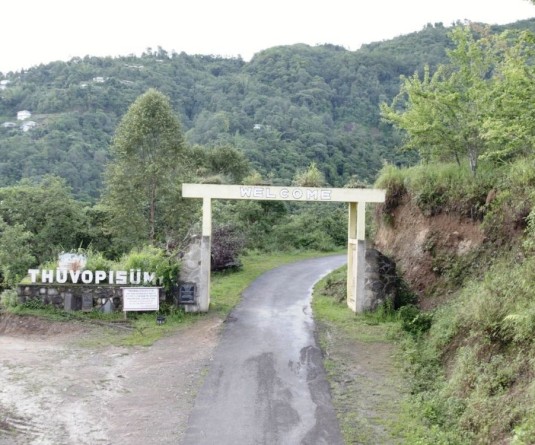
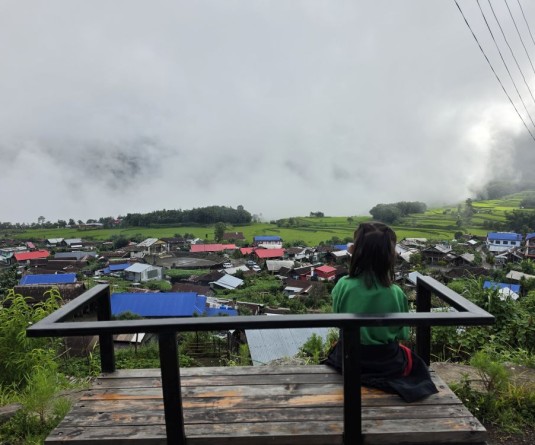
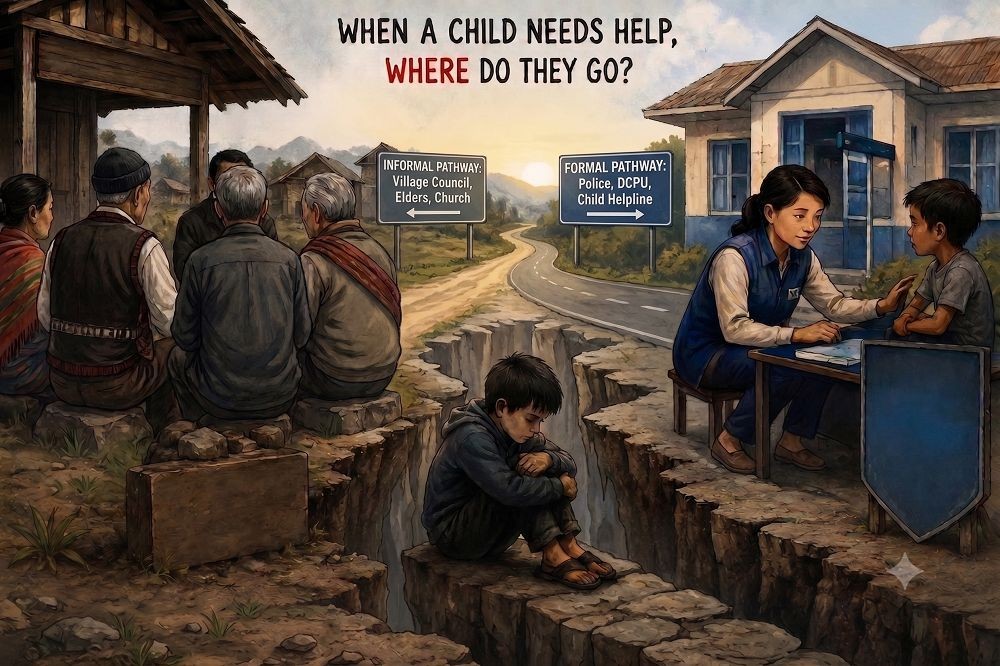
In many communities, the first step to justice starts with a village council. But under the POCSO Act, silence or a private compromise is never an option, it is a punishable offence (AI-generated illustration)
Informal settlements can leave children without counselling, care or legal recourse, says District child-protection workers
Yarden Jamir
Mokokchung | August 25
“Everything comes under the council,” said a village council chairman when asked where families usually go if they believe a child in the village may be unsafe.
For many families, the village council may be the first place they turn to when a child is facing a problem. Other concerns may first come to a church leader, neighbour, teacher or community elder before reaching the police, a helpline or a child-protection authority. For the Mokokchung District Child Protection Unit (DCPU), that first response can be crucial. It can also be where a case disappears.
The first point of contact
The chairman said families in his village generally approach the council first. The council has no written child-protection procedure, and that its members had not received child-rights or child-protection training during his 3-years tenure, he added.
Asked what would happen if a serious concern involving a child arose, he said, “It will depend on the situation.” The chairman also said the council was not aware that a child facing abuse could be linked to counselling and other mental-health support.
A gap in preparedness
That uncertainty worries child-protection workers. “Customary law practices or compromises also hinder a lot,” a member of the Mokokchung DCPU team said while emphasising on community mediation and child rights.
According to the team, some families try to settle serious allegations privately to avoid shame, preserve relationships or keep a child’s identity from becoming public. But workers said a private settlement can leave the child without counselling, medical support, follow-up or access to the legal process.
The concern is particularly serious in suspected sexual-offence cases. Under the Protection of Children from Sexual Offences Act (POCSO), information about a suspected sexual offence against a child must be given to the police or the Special Juvenile Police Unit or Child helpline 1098, DCPU or CWC. A community settlement cannot replace that process. “The child is not getting proper counselling,” one team member said, referring to cases that are resolved quietly before they reach the child-protection system.
From report to support
The DCPU official said any concerned adult can report a child-protection concern through Child Helpline 1098. It said calls relating to Mokokchung are routed to the district team through the State control room. “Anyone can call 1098,” a team member said. “The child in need themselves or any concerned adult can call us.”
The team said the identity of callers is kept confidential. “Whatever case we deal with, we’re not supposed to share that even with our family,” a DCPU official said. “Confidentiality is rule number one.”
For urgent or “core” cases, the team said it aims to respond within an hour, assess the child’s immediate needs and connect the child to the appropriate service or statutory authority.
Its work includes reports involving missing or runaway children, suspected sexual abuse, physical abuse nutritional and medical needs, bullying, emotional distress and documentation problems. Children may require counselling, emergency care, legal linkage, temporary care or help accessing basic entitlements such as birth certificates and Aadhaar cards.
From January 2024 until the time of the interview, the DCPU team estimated that it had handled around six or seven cases involving sexual offences against children and more than 20 cases of missing or runaway children. It also said it assists around four to five nutrition-related cases and a similar number of counselling cases in an average month.
The figures are estimates provided by the DCPU and reflect cases that reached its system. They do not represent the total number of child-protection concerns in Mokokchung district.
When a case stays hidden
That distinction matters. Many child-protection concerns may not begin as criminal complaints. A teacher may see a child repeatedly missing school. A neighbour may notice poor nutrition or neglect. A church member may hear of violence in a home. A youth leader may learn that a child is being bullied in a hostel.
Such concerns may still require urgent intervention. But workers said they often remain within families or communities, with no clear referral to the systems meant to support the child. Confidentiality, they stressed, should not be mistaken for silence. A child’s identity can be protected while the case is reported. Failing to report, however, can deprive the child of the support intended to protect them.
The village council chairman said there had been no known sexual-offence cases in his village during his tenure. He maintained that cases arising within a village usually come before the council and said customary institutions can take strong action.
Village councils and other community institutions are trusted, accessible and deeply rooted in community life. They can mobilise support quickly, calm a family in crisis and make it easier for a neighbour to speak up. They may also be the first to notice when a child needs help.
But they are not a substitute for systems designed to investigate serious offences, arrange care and ensure long-term follow-up for a child. The POCSO Act mandates compulsory reporting of all sexual offences against children. Non-compliance is an offence under law and is punishable with imprisonment of up to six months, a fine, or both. However, in cases where matters are handled by Village Councils, the typical outcomes are fines or social boycott. Such measures fail to address the needs of the victim and do not serve as a deterrent. Often, the accused simply moves to another location, which allows them to escape accountability and creates further risk to other children.
From private settlement to protection
The DCPU team said it has conducted awareness programmes with village councils, schools, churches, youth organisations, civil-society groups, police and the Sakhi One Stop Centre. Yet the interviews show that knowledge of counselling, reporting duties and referral pathways remains uneven. Child protection is everyone’s responsibility, and ignorance of the law is no longer an excuse. Institutions including churches, village councils, student unions, SHGs, unions, hostels, hotels, hospitals and police stations etc should prominently display child helpline numbers and key provisions of child protection laws to ensure maximum visibility.
“Awareness is the answer,” the DCPU team said. In a place where the first call often goes to a village council, awareness can determine whether a child’s concern ends in a private compromise or leads to protection, care and justice. The law looks at what we do, not what we meant to do. Under the POCSO Act, not reporting a case and settling it privately are punishable offences.
Names of the individuals have been left anonymous either due to requests for anonymity or to protect identities.
This report is part of the ‘Media Fellowship Initiative on Child Protection Awareness and Ethical Public Discourse’ series, supported by DKA Austria and implemented by Prodigals’ Home. The content is intended for public legal literacy and preventive awareness and does not constitute legal advice.