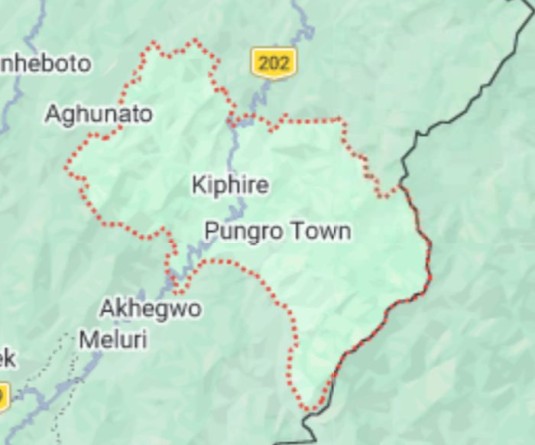
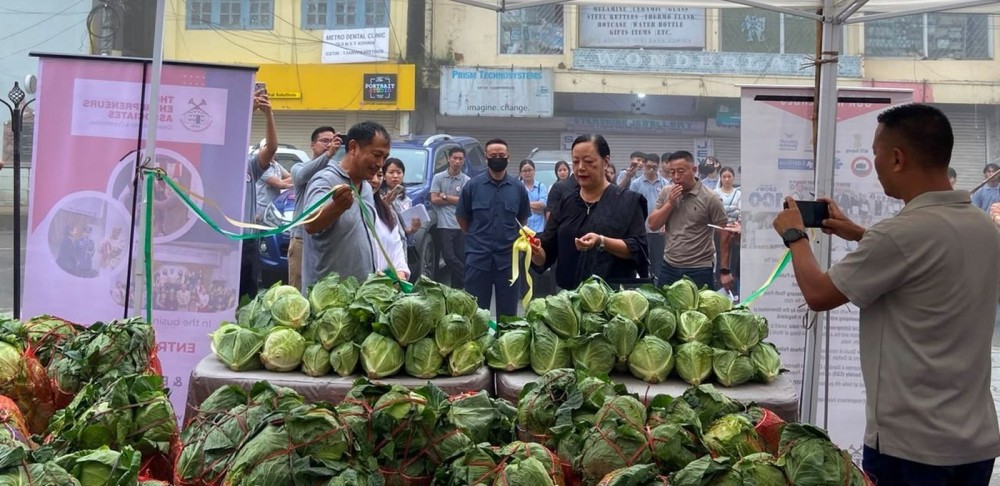
Salhoutuonuo Kruse at the charity cabbage sales drive in support of Razeba Range farmers in Kohima on July 16. (Morung Photo)
Our Correspondent
Kohima | July 16
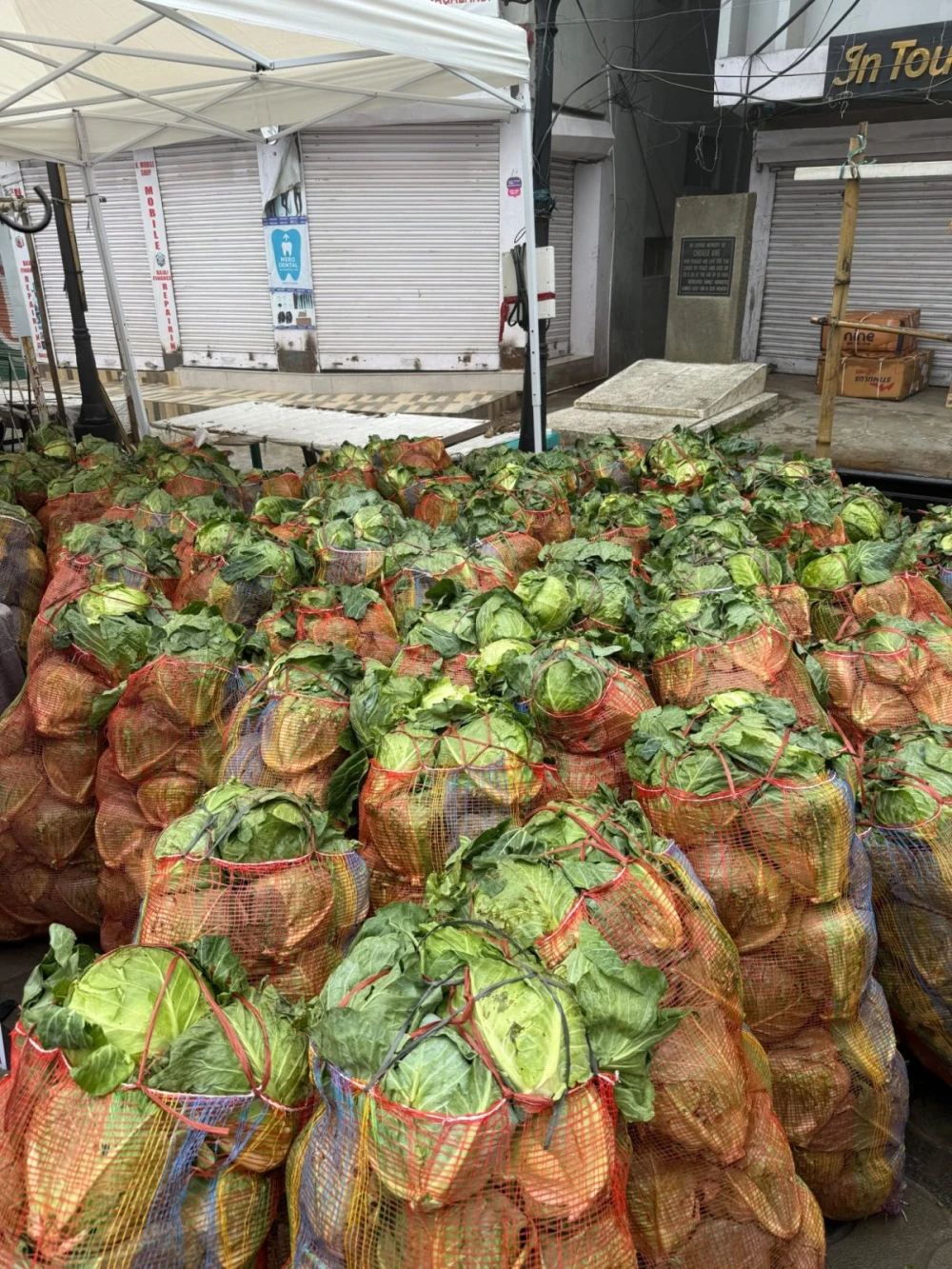
In an attempt to provide a quick respite to cabbage farmers affected by the disruption of markets in Manipur, The Entrepreneurs Associates (tEA) on July 16organised charity cabbage sales drive in Kohima, beginning with 30,000 kgs for the first phase.
The initiative aims to target sales of 1 lakh kgs of cabbage from Phek District to help farmers reduce crop wastage in their fields.
The initiative was launched by Salhoutuonuo Kruse, Minister for Horticulture & Women Resource Development, Nagaland.
Speaking at the launch program at Old NST, Kruse shared that while the Department of Horticulture was looking for ways to address the difficulties faced by cabbage farmers, she immediately thought of the Entrepreneurs Associates and contacted the CEO, Neichute Doulo, who promptly responded, leading to the launch of the initiative.
She noted that Nagaland's farmers are producing not only to meet local demand but also for markets outside the state.
However, the market disruption in Manipur has severely affected exports, leaving farmers with limited market options.
She thanked tEA for stepping forward to support both the farmers and the people of Nagaland.
Encouraging the public to support local farmers, Kruse said, “We must support and respect our local farmers who have worked hard to grow them despite harsh and unfavourable weather conditions."
She was accompanied Akumla Chuba, secretary horticulture department, Government of Nagaland and several other department officials.
Hope to curb 25-30% cabbage losses
tEA CEO Neichute Doulo thanked the Department of Horticulture for supporting farmers at a time when the market blockade in Manipur has left thousands of cabbages without buyers.
Doulo said that while Nagaland has fertile land and the majority of its people depend on agriculture, the sector will continue to remain at a subsistence level unless commercial agriculture is promoted.
He noted that the Department of Horticulture has been encouraging farmers to move in that direction.
He also thanked Kruse for the commitment to take up the long-term intervention of a Warehouse attached with a Mini Solar Cold storage and Agri Kiosks along the NH 29 for market access of horticultural produce across the state.
According to local community leaders, nearly 300 to 400 MT tonnes of cabbages are currently at risk of spoilage due to the lack of market access.
While acknowledging that the organisation alone cannot solve the entire problem, Doulo said that, with the support of the Department of Horticulture, EA hopes to prevent at least 25 to 30% of the potential losses by bringing the produce to market.
tEA’s CEO shared that the organisation’s association with cabbage and potato farmers in Phek district date back to as early as 2003.
In those days farmers struggled to sell their produce owing to market monopoly by established networks, where only a few traders were permitted to trade in potatoes and cabbages. In addition to this, the cabbages got easily spoiled due to the absence of cold storage facilities.
By 2006, the organisation also provided loans for potato and cabbage cultivation further fuelling this farm enterprise.
During this time, the organisation also took the responsibility for selling the products across the state.
He recalled that in Mokokchung, the proactive intervention of the Mokokchung Chamber of Commerce led by Bendangnukshi Longkumer, who halted imports of cabbages from Assam to facilitate marketing of the local cabbages has led to the scaling of the cabbage cultivation in the Phek District, particularly the Razeba Range.
This started the first Inter District Trade in 2006. In addition, the Regional Business Meetings that tEA had organised from 2015 onwards facilitated networking between farmers and neighbouring markets.
These experiences, he said, highlighted an important lesson: when farmers have access to reliable markets, they are willing to increase production.