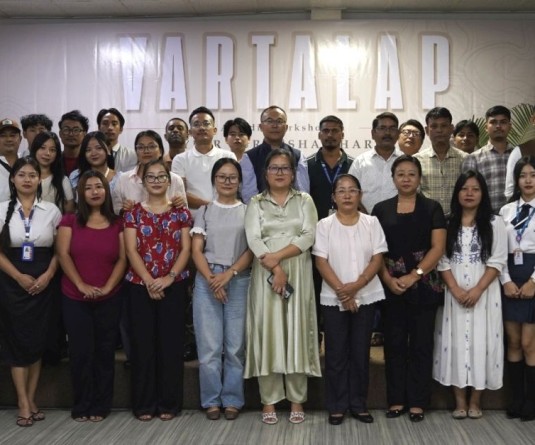
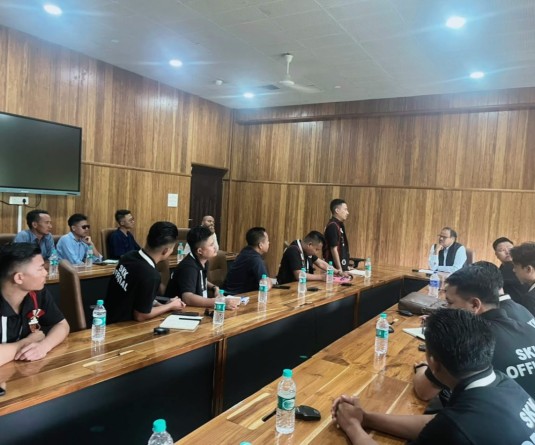
Kiphire district officials along with NagaEd members pose for a photo during the conclusion of the LEAP project in Kiphire on August 28.

Kiphire, August 28 (MExN): The Kiphire District Administration and NagaEd have concluded the Learning Enhancement and Accessibility Project (LEAP), a three-year digital education initiative that reached more than 1,200 students and 35 Mathematics and Science teachers across 15 schools in the district.
The project, implemented by NagaEd in partnership with the Kiphire District Administration under NITI Aayog’s Aspirational Districts Programme, was formally closed with the submission of its final report.
“Over the past three years, LEAP has strengthened digital infrastructure, built the confidence of our teachers, and expanded learning opportunities for students across Kiphire,” Deputy Commissioner Temsuwati Longkumer said.
“While the project has now concluded, the skills, resources and systems established through this partnership will continue to support our schools for years to come,” he said.
According to NagaEd, 96 per cent of participating teachers reported regularly incorporating digital learning resources into their classroom lessons by the end of the project, while 91 per cent said the project had improved the overall quality of education in their schools.
Teachers also reported increased confidence in using digital tools, with an average self-rating of 8.3 out of 10, the project report said.
LEAP began in June 2023 to address gaps in digital infrastructure, teacher capacity and access to relevant learning resources in participating schools.
A baseline assessment conducted by NagaEd involving 433 students and 75 teachers and school administrators found that more than half of the schools had no internet access, while three out of four teachers had never received formal training in digital teaching.
Only 15 per cent of students surveyed had previously used a personal digital device for learning, it said.
During the three-year implementation period, all 15 participating schools, including nine government and six private schools, were equipped with classroom Smart TVs, connectivity solutions and access to NagaEd’s Digital Class platform.
More than 1,400 curriculum-aligned Mathematics and Science learning resources were developed for Classes 9 and 10, including instructional videos, interactive practice questions, presentations and assessments.
The project also focused on teacher development, with more than 35 teachers participating in continuous professional development through classroom mentoring, refresher training, on-site coaching and ongoing support through a dedicated WhatsApp community.
At Government High School, Yangphi, Mathematics teacher Daniel Sechopi Sangtam said the project had changed classroom teaching.
“Classrooms have changed to more of an interactive class than that of a traditional way of teaching,” he said.
The project also adapted its approach to the challenges of working in a remote and geographically difficult district. While 78 per cent of teachers identified unreliable internet connectivity as a major challenge and 65 per cent reported frequent power outages, LEAP expanded offline learning support through pen drives containing video lessons, presentations and practice materials, along with printed assessments.
With access to personal digital devices remaining limited among students, the project increasingly focused on teacher-led classroom learning using Smart TVs, enabling students to participate in digital lessons regardless of whether they owned a device at home.
By the final year, 90 per cent of teachers reported that digital resources significantly reduced the time required to prepare lessons, while 87 per cent said the project's focus on prerequisite concepts strengthened students' foundational understanding.
At Trinity School, Kiphire, Mathematics teacher Sou O Lohrii said digital resources had helped address difficulties in teaching Mathematics without visual aids.
“Before LEAP, teaching mathematics was very difficult without visual aids. Many concepts were hard for students to understand. Thanks to LEAP for helping solve those challenges,” Lohrii said.
Although the project has formally concluded, participating teachers will continue to receive free access to NagaEd’s Digital Class platform and offline teaching resources to help sustain the use of digital learning resources beyond the project period.
“LEAP is more than introducing technology into classrooms. It is about building teachers’ confidence, improving learning opportunities for students, and demonstrating what is possible when government, communities and development partners work together,” NagaEd Founder Kevisato Sanyu said.