Millet – a crop that can withstand drought-like conditions, irregular rainfall, heat and poor soil, while its relatively short maturity period and low input requirements make it suitable for cultivation in the State’s hilly and marginal lands. (Morung Photo)
.jpg)
2nd Millet Festival at Kezoma village promotes sustainable farming
Morung Express news
Kohima | August 26
Millet has suited and survived difficult terrains and slopes of Nagaland where other crops have not thrived, Agriculture Production Commissioner (APC) and Commissioner & Secretary, Agriculture and Land Revenue, Government of Nagaland, Dr Zasekuolie Chusi said on Wednesday, underscoring its global resurgence and particular relevance for the State in the face of climate challenges.
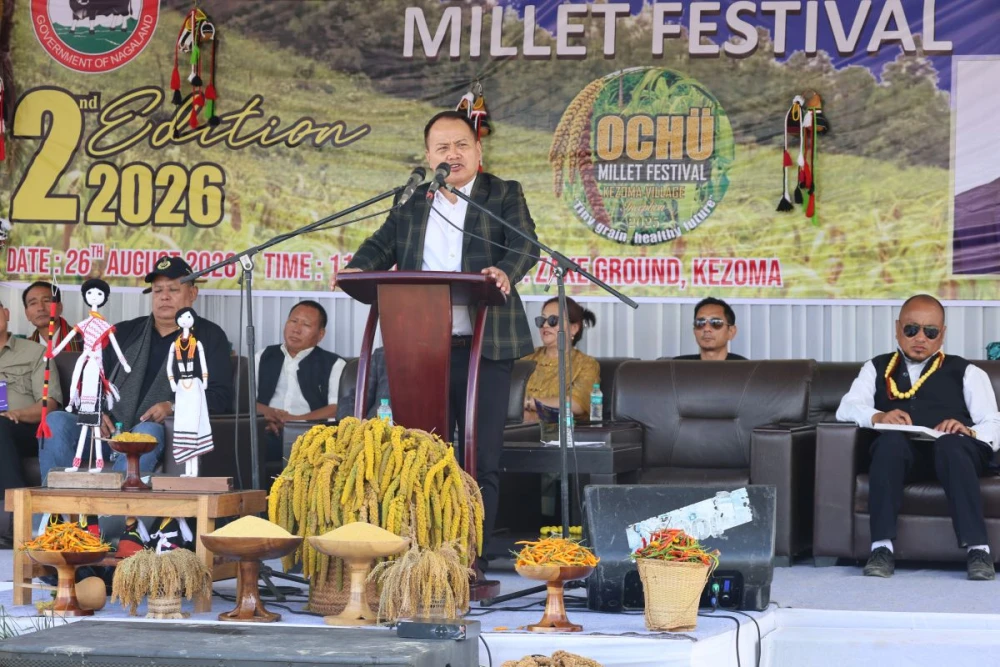
Speaking at the 2nd Edition of Millet Festival at Kezoma village, Dr Chusi highlighted millet can withstand drought-like conditions, erratic rainfall, extreme heat and poor soil quality. Its short maturity period and low input requirements make it ideal for cultivation in the State’s hilly and marginal lands, with certain varieties can also be cultivated more than once a year.
The Festival was organised by Kezoma Village Council in collaboration with the Department of Agriculture and allied sectors, Government of Nagaland.
Describing millet as an important crop for food and nutritional security, Dr Chusi said its relevance extended beyond its nutritional value, with continuing research also exploring medicinal properties and potential health benefits. However, he urged farmers and communities to reflect on the changing nature of agriculture and rural livelihoods, pointing out that many villages are gradually abandoning paddy cultivation due to declining economic viability.
‘The question was whether farmers were making the best use of their time and available land by exploring alternative and complementary agricultural activities or other activities,’ Dr Chusi said, calling for an improvement in farming techniques through the appropriate integration of traditional knowledge and modern technology and machinery. He emphasised that the objective should not be limited to self-sufficiency but should focus on building sustainable livelihoods and a stronger rural economy.
Referring to Kohima district and the Angami areas, he observed that the region is endowed with favourable conditions for cultivation, including good weather, rainfall, water resources and forests. At the same time, he urged introspection on whether increasing comforts have made society complacent and less inclined toward productive agricultural work.
.webp)
“Beyond millet, we must also ponder on other avenues such as cash crops, poultry, and other allied activities. We need to revisit ourselves and explore how agriculture can create better livelihoods,” he said.
Dr Chusi noted that the organising committee had informed him about recurring drought conditions in the Kezo range. However, the introduction and cultivation of millet had helped improve farmers' incomes, with some reporting that their earnings had doubled. ‘This success has provided further reason to celebrate the second edition of the Millet Festival,’ he added.
Calling for greater convergence among government departments, the APC requested officials from agriculture and allied sectors to interact directly with the farmers of Kezoma village and understand their needs. Assistance, he said, should extend beyond crop cultivation to issues relating to seeds, irrigation, land use, soil conservation and animal husbandry.
He also requested concerned departments, including veterinary and other allied sectors, to engage with the villagers and the organising committee, extending whatever assistance possible within their respective mandates. Expressing hope for sustained engagement, Dr Chusi said government departments would endeavour to hold more interactions and consultative meetings with Kezoma village and Millet Clubs to support community agricultural initiatives and strengthen millet-based livelihoods.
The Director of Agriculture, Government of Nagaland, Sanuzo Nienu observed that there was decline of millet cultivation in the region, however, remarked that it was encouraging to see growing efforts towards revival in recent years.
.webp)
Describing the renewed interest in millet cultivation as a “reawakening” among community farmers, Nienu assured that the Department of Agriculture would extend support to farming communities that are serious and committed to agricultural activities.
Encouraging farmers, the director highlighted the benefits of millet and noted its resilience and ability to produce good yields even under drought conditions. He said foxtail millet, in particular, is commonly grown in Nagaland and was traditionally a staple food for many communities.
District Agriculture Officer, Kohima, Kekhrieletuo Yhome, said Kezoma village had been a torchbearer in adopting and implementing various programmes and improved farming practices introduced by the Department of Agriculture.
He highlighted the village's success in the System of Rice Intensification (SRI), under which about 98 per cent of its paddy cultivation has been brought under the SRI method. The adoption of double-cropping practices, he added, had also enabled farmers to generate additional income from their agricultural land.
Yhome said the department had, in turn, extended support to the farmers through the provision of agricultural machinery. With millet cultivation being undertaken on a larger scale in the village, threshing and milling machines had also been provided, considering that these processes are among the most labour-intensive stages of millet cultivation.
The modern machines, he said, would significantly reduce manual labour, save time, improve efficiency and help minimise post-harvest losses.
The event was also addressed by Agriculture Production Commissioner (APC) and Commissioner & Secretary, Agriculture and Land Revenue, Government of Nagaland, Dr Zasekuolie Chusi.
The Kezoma Village Women Society presented a folk tune. Vote of thanks was proposed by Organizing Committee Secretary, Kedivi Mekro. Earlier, the programme was chaired by the convener, Mhasivi Naki. It began with an invocation by Ketholesie Mekro, Catechist, St Mary’s Church, Kezoma, followed by a welcome address by Kezoma Village Council, Chairman, Kikrosa Naki.
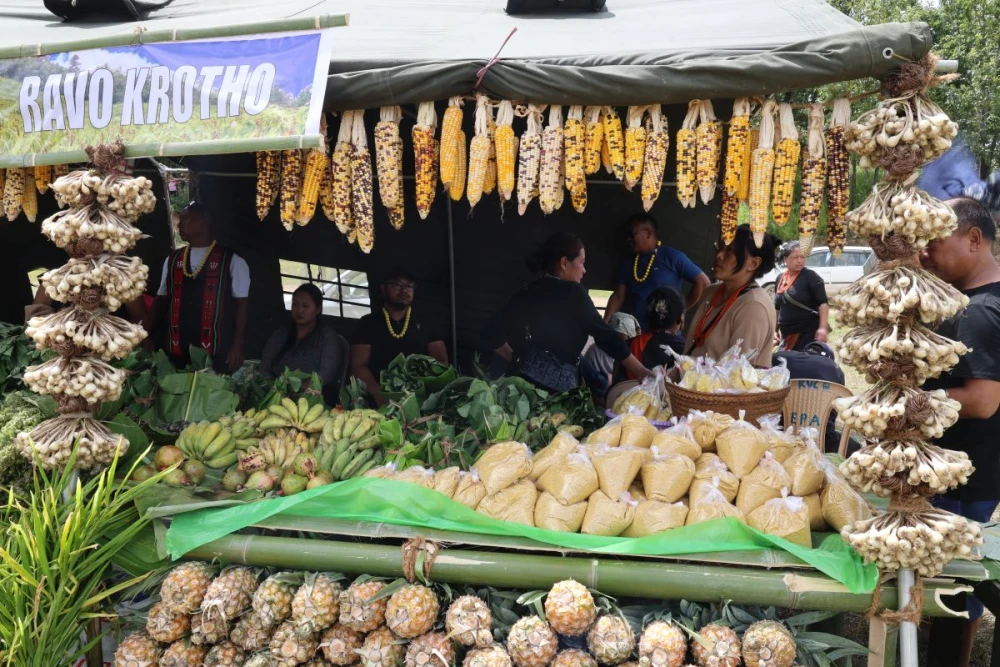
More than 20 stalls from Kezoma village and neighbouring villages sold their produces. During the day, over 1000 kilograms of millets cultivated by the villagers and harvested this year in July were sold alongside organic vegetables, fruits, and other produces of the villages were sold.