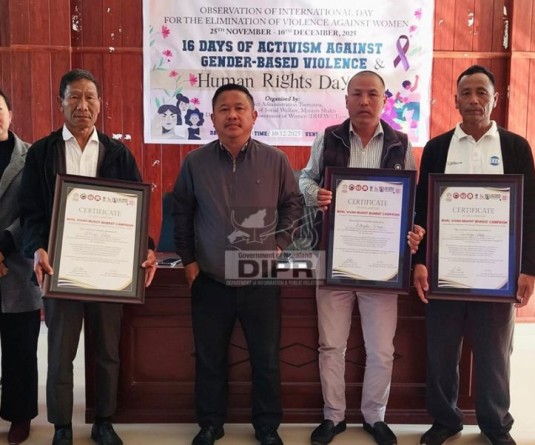
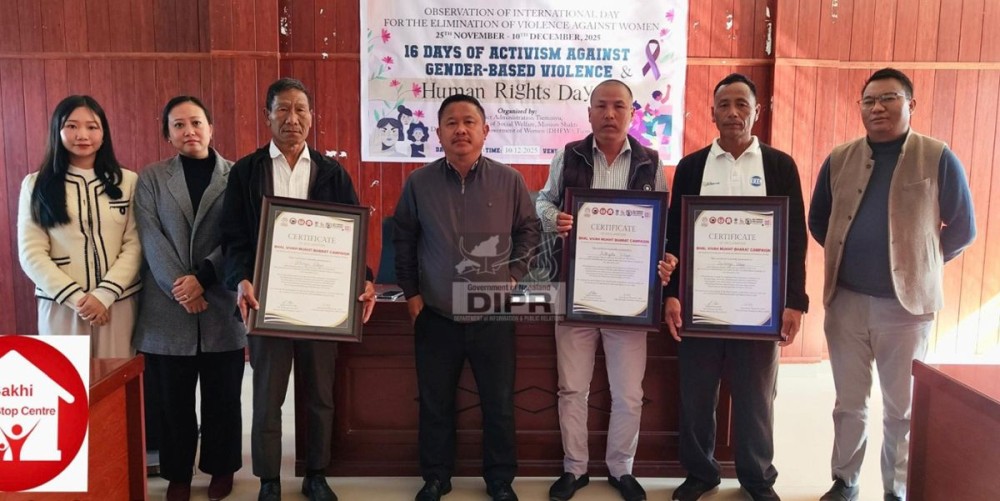
DC Tseminyu, Japheth Woch and officials with recipients of certificate of declaration of child marriage free villages at an event held at DC's conference hall, Tseminyu on December 10. (DIPR Photo)
Morung Express News
Dimapur/Tseminyu | December 10
The Tseminyu district administration has officially declared Kithagha, Tseminyu and Khenyu villages as the first “child marriage free villages” in Nagaland on December 10.
This initiative makes Tseminyu the first district in the State to formally adopt a community-based declaration against child marriages, the State DIPR informed.
The declaration was made during the culmination of the 16 Days of Activism Against Gender-Based Violence and the observance of Human Rights Day, held at the Deputy Commissioner’s Conference Hall, Tseminyu, on December 10.
It was implemented under the 100 Days Campaign of “Child Marriage Free India” of the Department of Women and Child Development, focusing on community ownership in ending child marriage.
Ahead of the declaration, the villages were sensitised by the Child Marriage Prohibition Office, Tseminyu, led by Kenyuhyule Thong, on the roles and responsibilities of village panchayats and community leaders, as well as on the legal provisions of the Prohibition of Child Marriage Act (PCMA), 2006.
The State DIPR further informed that the initiative was taken under the leadership and supervision of DC Tseminyu and Chairperson, District Level Committee (DLC) Mission Shakti, Japheth Woch, with the objective of achieving a child marriage free district.
During the event, the DC underscored the significance of Human Rights Day and highlighted that freedom from child marriage is a fundamental human right, while reiterating the role of the community in protecting children’s dignity, safety and future.
Safeguarding children is a collective responsibility, he said, urging communities to remain vigilant in protecting the future of every child.
Chairman of the District Child Welfare Committee, Jetilo Apon, and Legal-cum-Prohibition Officer (LCPU), DCPU Tseminyu, Neivotuonu Rutsa, also shared experiences on the occasion.
Participants included representatives from various civil society organisations and stakeholders from different government departments, along with village leaders, women and youth groups.
The district administration expressed hope that the initiative would inspire other districts in Nagaland to replicate the model and work towards the elimination of child marriage, the report added.
Child marriage in Nagaland
Officially, no cases of child marriage have been registered in Nagaland under the PCMA since 2010, when the National Crime Records Bureau (NCRB) first started publishing data on crimes under the Act. Across India, there were 6038 cases under PCMA Act in 2023.
However, this does not necessarily reflect the non-existence of girls or boys marrying or starting families without completing their legal age in Nagaland.
The periodic National Family Health Survey (NFHS) reports offer some insights. The latest NFHS-5 (2019–20) data indicate that 5.6% of women aged 20–24 in Nagaland were married before turning 18. Among men aged 25–29, 5% were married before the age of 21.
Besides, 3.8% of women aged 15–19 in Nagaland were either mothers or pregnant during the NFHS-5 survey, compared to the national figure of 7%. However, the rate of child marriage among women has declined significantly from 18% in NFHS-3 to 13.4% in NFHS-4 (2015–16) and 5.6% in NFHS-5. Similarly, the rate among men dropped from 8% in NFHS-4 to 5% in NFHS-5.
Incidentally, in a judgment related to the PCMA on October 18, 2024, a Supreme Court Bench comprising then Chief Justice of India D Y Chandrachud and Justices J B Pardiwala and Manoj Misra expressed scepticism over claims that several States and Union Territories (UTs), including Nagaland, had reported zero cases of child marriage over the past three years.
Low numbers, the Bench held, could also indicate underreporting or a lack of awareness among authorities and communities.
The NFHS data affirm this view and suggest that marriage or family formation before the legal age persists in Nagaland.