Morung Express News
Kohima | March 27
The Nagaland Budget 2026–27, presented by Chief Minister Neiphiu Rio on March 26 at the 8th Assembly Session of the 14th Nagaland Legislative Assembly received strong support from members during discussions in the Assembly, with legislators describing it as “visionary, inclusive and future-focused.”
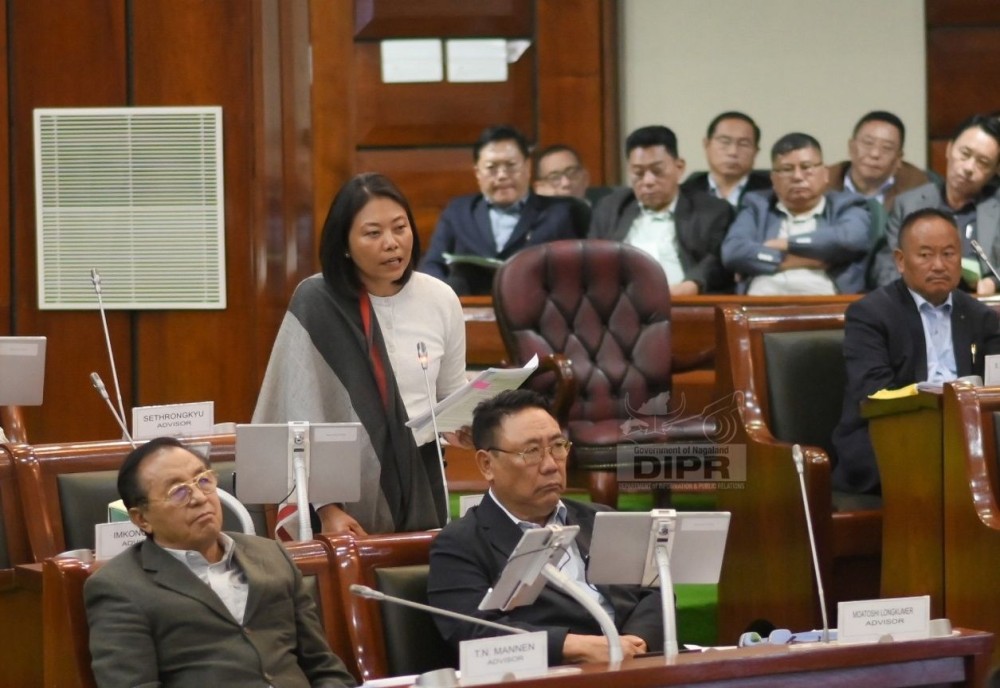
Opening the discussion, Advisor, Hekani Jakhalu Kense expressed gratitude to the Chief Minister and Finance officials for enhancing the Local Area Development Programme (LADP) allocation by Rs. 20 lakh. The additional fund, earmarked for skill development and promotion of micro-enterprises, was seen as a direct response to earlier deliberations on strengthening the MSME sector in the state.
She maintained that despite financial constraints, the government has taken steady steps towards the larger goal of “Viksit Nagaland 2047,” with targeted investments aimed at boosting economic growth, and also described the budget 17 new initiatives as ‘exciting’ spanning agriculture, water management, education, sports and employment generation.
Among the highlights, she commended the women-centric initiatives such as the Innovation Seed Fund for women entrepreneurs, 50 “pink scooty taxis” and also the Nagaland Weavers Advancement and Market Formalisation Initiative.
“The budget clearly reflects that women are being treated as equal stakeholders in the state’s development,” she said.
Also citing Rs. 5.3 cr for sericulture development, dedicated funding for women-led startups under Startup Nagaland, and Rs.4.3 cr for livelihood programmes under the Department of Women Resource Development, Kense these underscore the government’s focus on inclusive growth.
Informing the state’s current fish production which stands at 11,692.88 metric tonnes, Advisor for Fishery, Panjun Jamir emphasised on the need to enhance the fish production while the requirement stands at 22,000 metric tonnes which is being imported from outside the state.
As the demand of the fish continues to increase there is a real need to balance production with sustainability to curve and become self-reliance, said Jamir adding that a balanced approach is required for responsible management of ponds, reservoirs, rivers and huge streams with technology-driven activities towards a vibrant and resilient fisheries sectors.
Participating in the budget discussion, Achumbemo emphasised that the government must prioritise financial self-reliance by curbing excessive borrowing and reducing the fiscal deficit. He stressed that proactive engagement with the Centre for early oil exploration and a realistic review of the state’s prohibition policy could significantly strengthen Nagaland’s economic position.
“As a government, we must use every available means to become financially self-sustaining and independent in the interest of our people,” he said.
Achumbemo also expressed appreciation for the budget presented by the Chief Minister, who holds the finance portfolio, while seeking additional time to elaborate on key issues affecting the state.
On the Naga political issue, Achumbemo reaffirmed the state government’s commitment to an honourable and negotiated settlement. While noting that the Government of India has officially recognised the matter as a political issue, he asserted that its resolution must remain at the political level, rather than being left to bureaucratic processes.
Reflecting on history, Achumbemo noted that the Naga issue extends beyond the present geographical boundaries of Nagaland, encompassing Naga communities across neighbouring states and even across international borders.
Strongly dismissing the allegations that the present government was hindering progress, Kikon maintained that regional parties like the Naga People’s Front remain committed to protecting Naga identity and securing a lasting solution.
Advisor, Dr. Kekhrielhoulie Yhome lauded the State Budget 2026-27, describing it as a “rare” and carefully managed financial plan presented despite ongoing fiscal constraints and reduced central support.
Participating in the budget discussion, Yhome said the government’s ability to present a full budget under challenging circumstances termed it as ‘deferred budget and gestational budge.’
He noted that Nagaland has faced persistent fiscal stress since 1989, when changes in central funding patterns reduced the level of support for administrative expenditure, leaving the state grappling with deficits, especially ‘fiscal deficit.’
Drawing comparisons over the past five to six years, Yhome highlighted gradual but significant improvements in the state’s fiscal position. Total receipts, he said, have increased from Rs. 20,826 cr in 2020–21 to Rs. 22,507 cr in the current budget. Similarly, he said, the state’s own revenue has shown strong growth, rising from Rs. 1283 cr in 2021 to Rs. 2714 cr last year.
He also pointed to better debt management, noting that debt servicing has reduced from nearly 30% of the state’s budgetary allocation in 2021 to about 11.6% in the current fiscal.
While acknowledging the state’s continued dependence on central assistance, Yhome credited the Chief Minister for adopting a prudent approach. “There has been a huge improvement in fiscal management over the past five years,” he remarked.
Meanwhile, Yhome raised concerns about spending patterns in the education sector noting that between 2020 and 2025, the state spent over Rs. 9400 cr on school education.
Hee welcomed new elements introduced in the budget, including the creation of special purpose vehicles for innovative initiatives and the integration of Sustainable Development Goals (SDGs) into planning.
Other members who participated in the discussion include Tongpang Ozukum and Dr. Neisato Mero.
Members described the budget as “a practical roadmap” for long-term development and expressed confidence that its transparency and inclusive approach would accelerate growth while ensuring benefits reach all sections of society.
“The 2026-27 budget is not just a financial statement, but a comprehensive blueprint for a resilient and progressive Nagaland” a member stated.