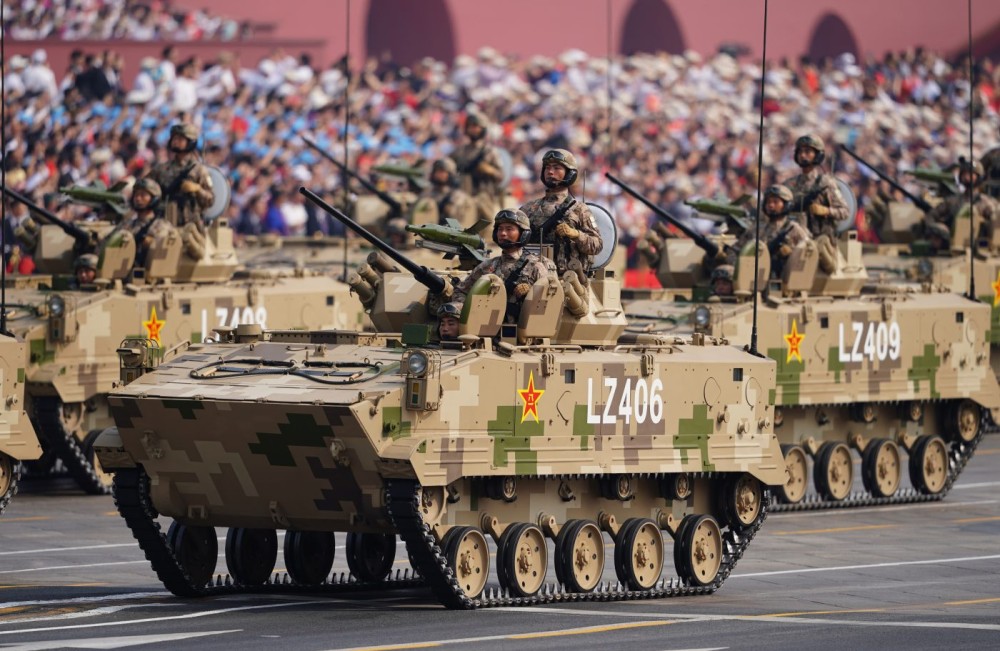
A formation of airborne fighting vehicles takes part in a military parade during the celebrations marking the 70th anniversary of the founding of the People\'s Republic of China (PRC), in Beijing, capital of China, Oct. 1, 2019. (Xinhua/Zhou Mi/IANS)
Washington, April 17 (IANS) China’s rapid military expansion and technological advances dominated a US Congressional hearing, with top intelligence officials warning that Beijing is accelerating capabilities across all domains to challenge American power.
Lawmakers were told that China remains the foremost strategic concern, with its military modernisation unfolding at an “alarming pace”.
Lieutenant General James Adams III, Director of the Defense Intelligence Agency (DIA), said the Chinese Communist Party is “rapidly developing military capabilities across all warfare domains designed to seize Taiwan by force while deterring U.S. intervention.”
He added that China’s expansion is reshaping the global security landscape.
Adams told lawmakers that Beijing now operates “more than 1200 satellites in orbit,” significantly enhancing its ability to conduct global surveillance. He also warned that China’s nuclear arsenal is growing quickly, noting that its warhead stockpile has “surpassed 600 operational warheads, with projections exceeding 1000 by 2030.”
The hearing highlighted concerns over China’s assertive behaviour in the Indo-Pacific. Adams pointed to “dangerous and aggressive actions in the South China Sea, particularly against the Philippines, using water cannons, ramming and other coercive tactics.”
Senior officials said China’s ambitions extend beyond conventional military power. Advances in artificial intelligence, cyber capabilities and space-based intelligence systems are enabling Beijing to compete across multiple domains simultaneously.
A senior representative of the National Security Agency told lawmakers that the strategic environment is “dynamic and complex, defined by great power threats,” with China central to that challenge. The official stressed the need for speed and agility in intelligence operations to counter such threats.
Undersecretary of Defense for Intelligence and Security Bradley Hansell said the US is investing heavily to “deter China in the Indo-Pacific,” including funding survivable intelligence, surveillance and reconnaissance capabilities and enhancing targeting and data collection in the region.
He said these efforts are part of a broader strategy aligned with the National Defense Strategy, which prioritises countering China through improved intelligence integration and stronger coordination with allies.
Officials also highlighted the growing technological competition with Beijing. Adams said China is investing heavily in “artificial intelligence, biotechnology, quantum sciences, and advanced microelectronics,” calling these sectors “foundational to future military innovation.”
He warned that China is already integrating AI into military systems, including “uncrewed systems, decision support, ISR and cyber ops,” which could expand its operational reach and effectiveness.
The hearing also underscored concerns about increasing coordination between China and other US adversaries. Adams said Beijing, along with Moscow, Pyongyang and Tehran, is working to “undermine the influence of the US and our allies,” though their partnerships remain complex.
During the hearing, Congressmen emphasised the need for stronger intelligence coordination and faster adoption of emerging technologies to keep pace with China’s advances. Officials acknowledged that processing vast volumes of intelligence data remains a challenge, and that AI is expected to play a critical role.
The testimony comes as Washington intensifies its focus on great power competition, particularly with China, which is widely viewed as the primary long-term strategic rival. Beijing’s military modernisation, expanding global footprint and growing technological capabilities have placed it at the centre of US defence planning.
Recent US defence strategies have increasingly prioritised the Indo-Pacific, where China’s assertiveness — from Taiwan to the South China Sea — has raised concerns among American allies and partners. Intelligence agencies are now central to monitoring and countering these developments in real time.
US targets China in missile defence push
China emerged as the central strategic focus of a high-stakes US congressional hearing on missile defence, with defence officials warning that Beijing’s expanding capabilities are driving a major overhaul of America’s homeland security architecture.
Senior Pentagon officials repeatedly identified China as the primary long-term challenge shaping the proposed “Golden Dome” missile shield, even as lawmakers clashed over its cost, feasibility and strategic logic.
“China is our pacing competitor,” Marc Berkowitz, assistant secretary of defence for space policy, told the House Armed Services subcommittee, outlining the rationale behind the new system.
He said the United States aims to “deter China from a position of strength, not confrontation”, signalling that the missile defence expansion is designed as much for strategic competition as for immediate threats.
The proposed Golden Dome system is envisioned as a layered, multi-domain defence architecture capable of countering ballistic, hypersonic and advanced cruise missile threats — areas where US officials say China has made rapid advances.
Berkowitz warned that US rivals are “expanding, diversifying and increasing the sophistication of their arsenals”, integrating missile and aerial systems into joint operations to challenge American power.
“These threats are designed to undermine our political will, social cohesion and ability to project power,” he said.
Military commanders reinforced the assessment, pointing to a rapidly evolving threat environment in which adversaries are not only improving their missile capabilities but also cooperating with one another.
General Gregory Guillot, commander of US Northern Command and NORAD, said adversaries are “relentless in their pursuit of more capability” and are sharing data and technologies to exploit weaknesses in US defences.
General Michael Guetlein, who leads the Golden Dome initiative, warned that “for the first time in a generation, our nation’s margin of safety has vanished”, with the US homeland increasingly exposed to advanced missile threats.
He said the new system would integrate space-based and terrestrial defences into a unified network to counter threats emerging from land, sea, air and space.
Lawmakers, however, sharply questioned whether the system would deliver on its promise. Some argued that missile defence could be outpaced by adversaries such as China, which are developing countermeasures and alternative attack strategies.
Seth Moulton, the ranking member, warned that recent US actions have “strengthened China’s hand”, questioning the broader strategic coherence of current defence policies.
He also cautioned that missile defence systems are inherently limited, saying they cannot provide an “impenetrable shield” against all threats.
Officials acknowledged that adversaries routinely adapt. General Heath Collins of the Missile Defence Agency said that “throughout history… adversaries immediately [try] to counter” new missile defence capabilities.
Despite the scepticism, the Pentagon maintained that the Golden Dome is essential to restoring deterrence against near-peer competitors, particularly China, by complicating attack planning and increasing interception opportunities.
The hearing comes amid intensifying US-China rivalry across military, technological and geopolitical domains, with missile defence emerging as a key pillar of strategic competition.
Analysts note that Beijing has invested heavily in hypersonic weapons, anti-satellite systems and integrated air defence networks, challenging traditional US advantages and accelerating the push for next-generation defensive systems.