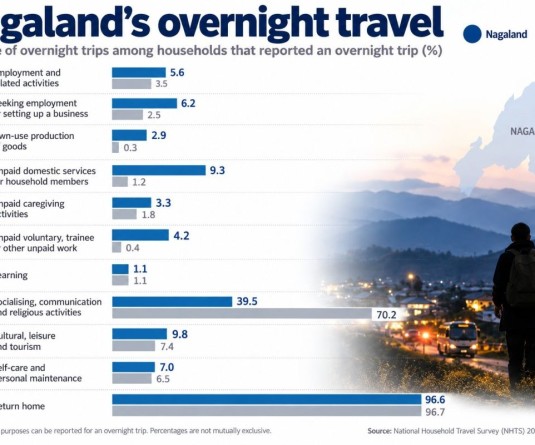
MLA Achumbemo Kikon, resource persons, NSCW members and participants during the state level seminar on ‘Women in contemporary Naga society’ at Kohima on April 17. (Morung Photo)
Morung Express News
Kohima | April 17
MLA Achumbemo Kikon described the evolving role of women in Naga society as a journey “from being seen as a source of trouble to becoming a source of strength,” highlighting both progress and the challenges that remain.
Speaking at the state-level seminar on ‘Women in contemporary Naga society’ on April 17, Kikon drawing from history and cultural narratives, said women were often blamed or sidelined in earlier times stating that that was the old way of thinking. However, he remarked that in today’s context, women are increasingly acknowledged as pillars of strength in families and society.
Focusing on Naga society, he said that while it has traditionally been patriarchal, with decision-making largely in the hands of men, there has been a gradual but visible shift. “Today, women are not just part of the process, they are shaping the outcomes,” he said.
He pointed out that women’s voices have long influenced decisions, even if indirectly, through family and community interactions. However, recent developments show that women are now taking their place more visibly at the decision-making table.
Citing recent civic body elections, Kikon noted that women secured over 37% of seats surpassing the 33% reservation mark. “This shows that women are not just relying on reservation; they are competing and winning on merit,” he said.
On education, he highlighted that female literacy in Nagaland has reached over 76%, reflecting a significant shift from earlier times when women’s roles were largely confined to the household. “From the kitchen to the classroom, and now to offices and leadership roles, the change is evident,” he added.
He also emphasised on the growing presence of women in government services, education and other professional sectors, noting that many institutions are now seeing strong participation from women. At the same time, he urged women to support one another rather than depend solely on men for encouragement. “Empowerment must also come from within. Women must uplift each other and ensure that capable individuals are chosen to represent them,” he said.
Touching on societal attitudes, he maintained that Naga society has always held women in high regard, often protecting and valuing them within the cultural framework. However, he acknowledged that perceptions of discrimination have also existed and said the way forward lies in ensuring women’s direct participation in governance and public life.
Empowering women a societal imperative
In her keynote address, NSCW Chairperson, W Nginyeih Konyak said, “women have always been the backbone of Naga families and communities, serving as custodians of culture and contributors to the economy, while increasingly taking on leadership roles in governance and public service.”
However, she pointed out that issues such as limited access to opportunities, underrepresentation in decision-making, and concerns around safety and discrimination still need attention.
Calling for honest reflection, she urged participants to examine how women are navigating education, employment, leadership and public life, and whether existing systems are evolving fast enough to support them.
“Empowering of women is not merely a women’s issue, it is a societal imperative,” stated Konyak adding that a progressive society cannot be built if half of its population remain underrepresented in spaces of power and policy.
The Commission reaffirmed its commitment to advocating women’s rights, addressing grievances, and creating platforms for dialogue. It also called for greater collaboration among policymakers, institutions and civil society to turn discussions into meaningful action.
The seminar organised by the Nagaland State Commission for Women supported by the National Commission for Women was held at SIRD Auditorium.