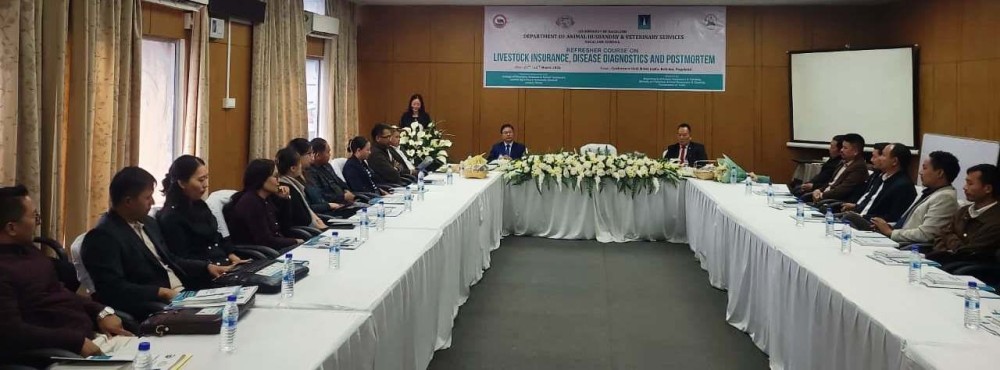
Angelina Tajen addressing the refresher course on livestock insurance, disease diagnostics and post-mortem at Hotel Japfu in Kohima on March 23. (Morung Photo)
Our Correspondent
Kohima | March 23
The Department of Animal Husbandry & Veterinary Services (AH&VS), Nagaland, on Monday stressed the need to scale up the livestock insurance scheme in the state to safeguard farmers’ livelihoods.
The call was made during a three-day refresher course on livestock insurance, disease diagnostics and post-mortem, which began at Hotel Japfu in Kohima on March 23. Officers of the department were urged to create mass awareness about the scheme across the state for the benefit of farmers.
Under the National Livestock Mission (NLM), the livestock insurance scheme offers affordable protection, with the beneficiary premium share reduced to a uniform 15 per cent. The scheme covers up to 10 cattle units per household, while the remaining 85 per cent of the premium is subsidised by the Centre and the state governments.
National Insurance Company Limited (NICL), established in 1906, is the country’s oldest general insurance company and operates under the Ministry of Finance, Government of India.
Livestock insurance provides financial protection to animal owners against death, loss or damage due to specified risks and also enables farmers to access bank loans by insuring their livestock. To avail the policy, farmers are required to contact the Chief Veterinary Office in their respective districts. NICL issues proposal forms, while district nodal officials provide health and vaccination certificates. Ear tags are also issued at the time of insuring animals.
High Animal Fatality Rates
Delivering the keynote address, Angelina Tajen, IAS, Secretary to the Government of Nagaland, AH&VS, said risks in livestock farming are “real and significant,” citing official 2023–24 data that recorded 45,196 poultry affected by diseases, with 17,873 fatalities. During the same period, 24,061 pigs were affected, of which 12,039 died.
“For a small farmer, the loss of even one animal can mean loss of income, food security and financial stability. Livestock insurance acts as a critical safety net, converting uncertainty into assured protection,” she said.
While acknowledging the potential of insurance schemes, Tajen said implementation challenges persist at the ground level, including difficulties in conducting post-mortems in remote areas, poor connectivity, limited access to veterinary personnel and procedural delays.
Highlighting gaps in poultry insurance, she pointed out that insurance companies require a minimum flock size of 1,000 birds, whereas the government scheme covers poultry units of 100 birds. “In Nagaland, most farmers rear small backyard units of 50–200 birds. This creates a serious exclusion, leaving many small farmers outside the insurance net,” she said.
Tajen stressed the need for practical and locally relevant solutions, including flexible claim verification, use of geo-tagged photos and videos, certification by field veterinary staff and cluster-based verification mechanisms.
She also called for inclusion of small poultry farmers through group insurance models involving SHGs and FPOs, relaxation of minimum flock size norms, risk-sharing support for insurers and improved accessibility of veterinary services.
“Livestock insurance is not the responsibility of one institution alone. It requires government support, administrative efficiency, insurance sector participation and, most importantly, farmer awareness and trust,” she said, adding that it is a commitment to protect farmers’ livelihoods.
“When a farmer loses an animal, it is not just a loss of livestock, but a loss of hope, security and dignity,” she added.
Earlier, AH&VS Director Dr Imomanen Tzudir delivered the welcome address, while entrepreneur Penyiisielie Suokhrie spoke on “Livestock insurance: Entrepreneur’s perspective and feedback.”
The programme, which will continue till March 25, is being organised by AH&VS Nagaland in collaboration with the College of Veterinary Science & Animal Husbandry, Central Agricultural University, Jalukie, Peren, and sponsored by the Department of Animal Husbandry & Dairying under the Ministry of Fisheries, Animal Husbandry & Dairying.
Types of animal coveted under Livestock Insurance
Types of Animal | Age Group |
Pig | 4-12 months/12 - 36 months |
Sheep & Goat | 4-84 months |
Cattle (Heifer) | 3-24 months |
Cattle (Milch) | 24-84 months |
Mithun | 24-84 months |
Buffalo | 24-84 months |
Claim Settlement
Types of Animal | Age | Sum insured |
Pigs | 4-12 months | Rs 15,000 |
Pigs (Breeding Sow) | 12-36 months | Rs 20,000- 25,000 |
Pigs (Breading Board) | 12- 36 months | Rs 20,000-25,000 |
Sheep & Goat | 4-84 months | Rs 6000 |
Poultry Layers(Minimum 1000 birds) | 3-36 months | Rs 400 |
Catle (Heifer) | 12- 24 months | Rs 40,000 |
Cattle (Milch) | 24- 84 months | Rs 60,000 |
Mithun | 24- 84 months | Rs 60,000 |
Buffaloes | 24- 84 months | Rs 60,000 |