Morung Express News
Mopungchuket | August 4
The Indian Himalayan Region (IHR), according to the Integrated Mountain Initiative (IMI), is being plagued by fast changing waste profiles and a rise in use of non-recyclable and single use plastics many of which have no solutions once trashed. IMI claims that globally as well as in the Himalayas, the waste crisis is increasingly being experienced as an issue that is harmful for the people and to the planet’s wellbeing.
“Products have been designed to easily move up the mountains but no systems evolved for it to flow back safely,” IMI says. IMI also says that the Indian Himalayan region has specific waste management issues of higher costs and access to the mountains is not reflected enough in the Waste Management Rules 2016.
According to IMI, waste management in the IHR is focused on centralized technological solutions only and not invested enough on behavioral change. IMI also says that visionary leadership with capacities that are essential to synergies and lead these initiatives are largely missing and that the Indian Himalaya Region needs “contextual, scalable pilots that provide a pathway and hope.”
According to IMI, zero waste principles offer sustainable pathways to address this waste crisis and demand solutions that move away from the “extractive linear production and consumption systems to waste reduction.” IMI says that “zero waste” calls on individuals, institutions and governments to strengthen, promote and institutionalize closed looped economies that are local, unpackaged with low carbon footprints and calls upon corporations to take responsibility for their waste and move to sustainable designs and products.
Priyadarshinee Shrestha, the secretary of IMI said that as part of The Himalayan Cleanup, IMI and ZWH are supporting selected peer educators to take forward zero waste pilots in their own areas through a call for proposals. According to her, the projects proposed by peer educators range from education for behavior change in waste to green enterprise setups. “Supporting these key projects would enable action on the ground to create positive stories from the Himalayas,” she concludes.
The Integrated Mountain Initiative (IMI) and Zero Waste Himalaya (ZWH) with support from European Outdoor Conservation Organization (EOCA) is providing opportunities to undertake zero waste pilots that are innovative, offer sustainable solutions with a community impact to the burgeoning waste crisis, especially plastic pollution.
Mopungchuket village under Mokokchung district of Nagaland state has been selected for a zero waste pilot project with local group The Greensight Project as their peer educators. The zero waste pilot project in the village will be an 8-month long exercise to be initiated by The Greensight Project with resource support provided by IMI and ZWH.
‘Zero Waste Mopungchuket’
In a rare development that is expected to lend impetus to the ongoing holistic cleanliness campaign of Mopungchuket village under Mokokchung district, the Integrated Mountain Initiative (IMI) and Zero Waste Himalaya (ZWH) has selected the village to implement a zero waste pilot project.
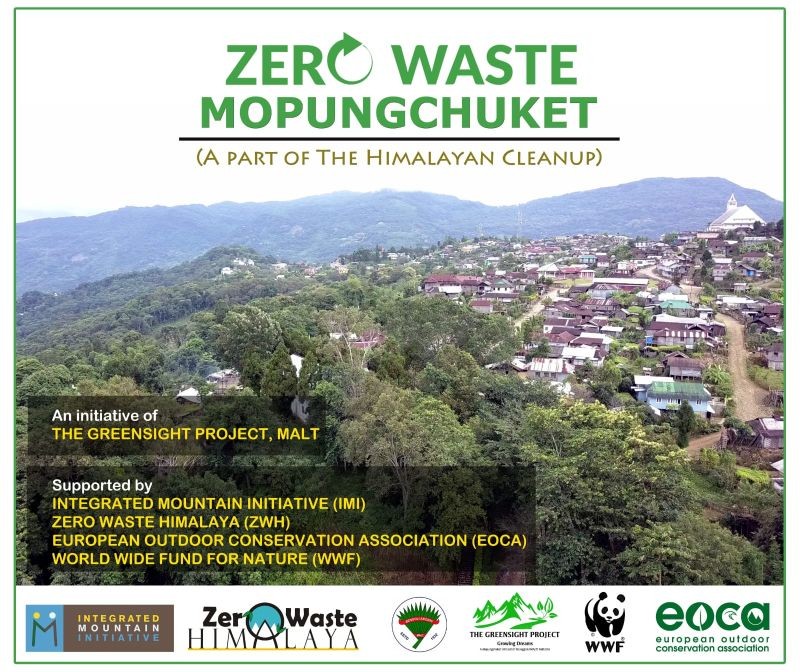
The 8-month long pilot project will be implemented by The Greensight Project under the title “Zero Waste Mopungchuket” with resource support provided by IMI for which a memorandum on Terms of Reference was formalized on August 2 last.
The zero waste pilots of IMI and ZWH, supported by the European Outdoor Conservation Association (EOCA), is a part of The Himalayan Cleanup which is an annual flagship programme of IMI conducted across the Himalayan states of India and anchored by ZWH.
Responding to a call for proposals announced by IMI and ZWH earlier this year, The Greensight Project submitted theirs and was selected as one of the 5 proposals selected for the pilots from all over the Indian Himalayan states.
Mopungchuket village is regarded as one of the cleanest villages in Nagaland and has in recent times emerged as the frontrunner in the state’s campaign against plastic pollution. The Greensight Project since its inception in the year 2016 and has been facilitating all cleanliness campaigns in the village in association with the village level organizations and stakeholders. All activities of The Greensight Project circle around its twin core principles of instilling behavioural change towards cleanliness and advocating sustainable practices for preservation of the natural environment among the villagers. The Greensight Project was launched by the Mopungchuket village students’ organization (MALT), which is a mandated apex body of the village established in the year 1932.
The principal focus of Zero Waste Mopungchuket pilot project will be on sensitization campaigns and onsite interventions to induce behavioural change among the villagers to adapt zero waste lifestyle in a sustained manner.
Some of the objectives of the pilot according to the Terms of Reference would include sensitization through IEC resources and audiovisual communication for mass awareness, a campaign to “make at home” promoting local unpacked food items, provision of locally sourced dustbins, streamlining of ongoing waste management in the village, strategic partnership with village authority, community engagement, exploring feasible options for providing alternatives to single use plastic items and compulsory household compost pits.