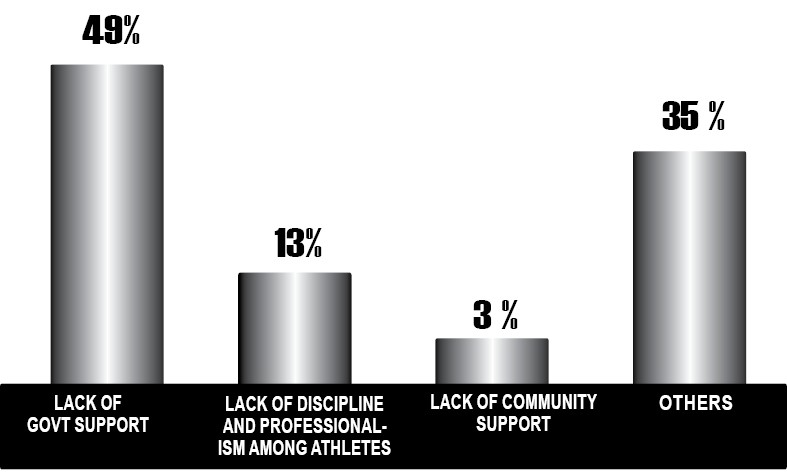
Lack of Government support:
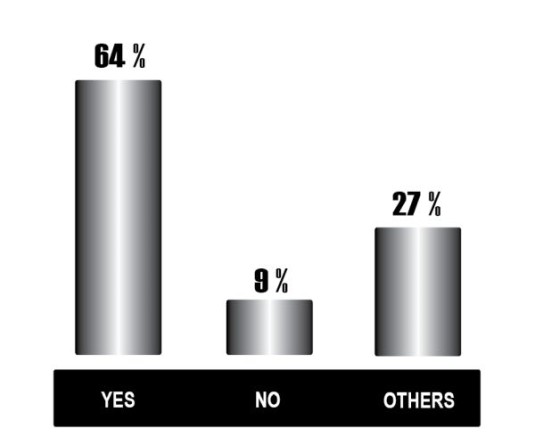
• The lack of Government support is the primary reason why sports industry remains shrouded in Nagaland. But that is not the only reason. We must also acknowledge the fact that, community participation/contribution is what actually drives the sports industry. We cannot always blame the government for every shortcoming. We need to make sure we are ready to part-take in the said venture. The community as a whole can boost the growth, while certain sections of society can spare their profound wealth in the overall development of sports. Nagaland has a huge potential to be one of India's best states for sports industry. There has been a rise of youths who, if given the opportunity, has prospects of becoming star sportsmen. Essentially, Nagaland is in dire need of infrastructure(s) and support.
Lack of discipline and professionalism among athletes:
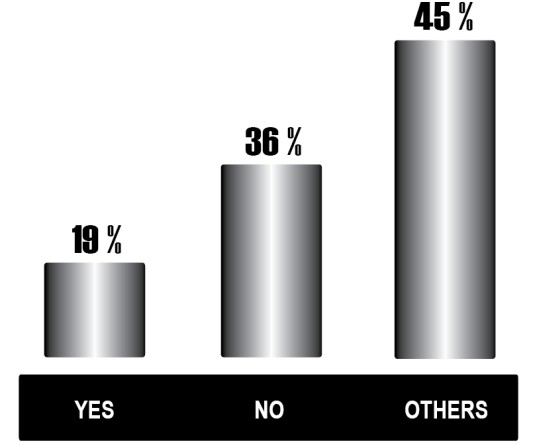
• One win and arrogance kicks in, partying day in day out, drinking, smoking, ghutka, no respect for referees are some reasons among many other reasons.
Lack of community support:
Others (Specify):
• All of the above. Lack of any incentives and attention from the government is one reason. Till today we do not have a single standard stadium of any sport field. This very one fact, lack of sports infrastructure, itself speaks volume. The effort is too less or negligent if we want to grow sports as an industry or a way of giving a platform to make it as our profession. Second, many players of different field also do not have deep enthusiasm, reasons may be there, as we already do not get support or facilities to enhance our skills. But many people who are into sports also end up giving up after some period of time nor do the players promote and start the initiatives to improve the understanding of the benefits it can give us. As players, it is not just about going out the field and playing the game. But since they have already experienced the hardships and limitations of our sports industry, they should be the ones working hard to improve and bring change at least for the younger generations. Someone like me who does not play sports, I have no such experiences, so I will not know how, where and what to do exactly to improve the reality of our sports conditions. Usually even many regarded sportsmen of different field end up chasing for some stable government jobs or so and do not take the torch ahead. Even if they could not make it, it will be good if they lead the fight to bring change. Of course I do not say nobody has done it, am sure there must be many people who have contributed or tried to bring change in our sports industry. But like I said it is far too less of an effort. We need more. Lastly, we are still stuck with the mentality that there is nothing to gain by giving our time and effort towards sports. We know the reasons for such a thinking. But it is time we come out of such thoughts and encourage our younger generations to pursue their interest as well. It is possible even when a child is going to school and getting formal education, by not discouraging them to dissociate from playing sports or any other activities. Especially if we see a child has interest in it and if we know that he or she can improve if we support. As such, it is not just one problem but many.
• At the core of choosing any profession, there lies a fundamental question, “is it sustainable?” This is precisely why sports or other unconventional professions are often sidelined. As the general perception legitimises traditional profession (government job) over others. But again where does this is perception come from? Who is really responsible? Is it the family that discourages children from pursuing unconventional professional pathways? or Is the government not doing enough to ensure sustainability for sports professionals? Perhaps, the issue is much deeper and ingrained in the entire ecosystem with a narrow definition of what “professionalism” is; one that equates with government jobs for lifelong security, sustainability, comfort, prestige, honour etc… Whereas, sports are often perceived as offering only short lived success and fame. We can draw so many key factors why unconventional professional pathways are not thriving. However I strongly believe the way forward to this pressing issue could be addressed by: ‘Redefining’ what professionalism is; ‘Reinforcing’ the existing ecosystem for sports professionals; ‘Education reforms’ where students are not only transformed by holistic learning but where parents are also equally impacted; Finally, encouraging students to ‘create’ not merely receive (Breaking the banking model of educational system, Paulo Freire). Ultimately, values are formed at home, where an individual first becomes part of the ecosystem. If families begin to accommodate sports as a viable career path, the wider ecosystem will follow suit.
• Corruption
• Lack of infrastructure
• Lack of peace and hospitality for the outsiders. The mindset of the people who stays there don't want to understand that people from outside comes and bring either tourism or FDI. The land distribution has to be done to outsiders otherwise outside people will always have fear and can never accustomed to the society. People of the land needs to have now liberal mindset, they are using 5G, that means they are not so outdated and need to understand that now it's time to come out from the tribe mentality.
• The primary obstacle preventing the sports industry from growing in Nagaland is the lack of proper sports infrastructure and long-term policy implementation. This problem is connected with funding delays, weak management systems, and limited professional opportunities for athletes. Nagaland has strong sporting talent, especially in football, basketball, and volleyball, but the sports industry cannot grow properly because of weak infrastructure, poor planning, inconsistent funding, and lack of professional support systems. If the state improves training facilities, governance, grassroots programs, and investment, sports could become a major source of employment and recognition for Nagaland.
• Young people of today’s generation must be serious in politics which doesn't mean we should become politicians rather one must to be wise and be bold enough to choose the right leader who can be the voice of common people in the Nagaland Legislative Assembly. Nepal should be an eye opener for all the like-minded young people that we have the strength and potential to bring changes in our society. In short, change should start from within.