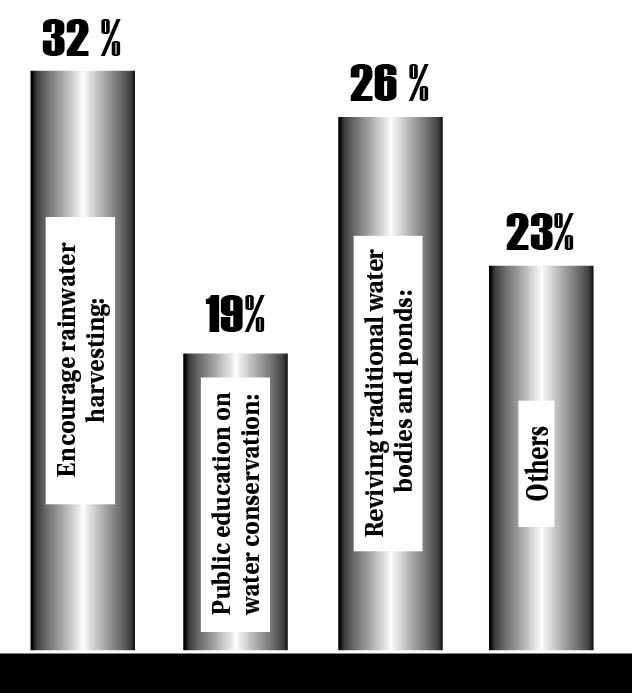
Encourage rainwater harvesting:
• Financial aid to construct rainwater harvesting water reservoirs
• I think the rainwater is best for us if we storage from the month of August and September
• Need of the hour rainwater harvesting. Build, stock and survive.
• The best option would be to harvest rainwater to the maximum. Also recharge the aquifer level by harvesting rainwater from maximum standing buildings including government infrastructure so as to raise the underground water table.
• The most effective method to address this is a community-driven, integrated approach centered on rainwater harvesting, especially rooftop and traditional systems — combined with spring revival, watershed management, and sustainable land practices. This aligns with Nagaland's topography, abundant monsoon rainfall, and cultural strengths. Rainwater harvesting blending modern rooftop systems with indigenous practices like Ruza, is currently the most effective, scalable, and sustainable solution for Nagaland water scarcity. It directly tackles the mismatch between seasonal abundance and dry-season shortages while being climate-resilient and community-owned. Scaling this through government schemes (like recent 2025 watershed missions) and local action can significantly alleviate the crisis.
Public education on water conservation:
• Because if we do not educate them that how to conserve water by doing all the above mentioned like traditional ponds will not help
• Because people waste in villages and run short in towns
• Rainwater harvesting, reviving traditional water bodies and ponds are age-old traditionally important methods to address water scarcity. Time has come to educate and sensitize Nagas on a large scale from rural to urban hubs in Nagaland. Climate change is real and is happening. We need to wake up.
Reviving traditional water bodies and ponds:
• In non-urban areas reviving traditional water bodies and nature conservation effort should start, otherwise the ones we have are already vanishing, before we reach an imbalance, time to bring traditional sustainable practices.
• Nagaland's countless number of streams and rivers can provide water for the entire population forever, so installation of water filters near them is necessary.
• One river is enough to meets the shortage of water if the Government shows seriousness in building better connectivity and storage facilities.
Others (please specify):
• All the above and one most important thing is planting more trees.
• By making the claimed and Jal Jeeva Mission in action.
• Change the politicians.
• Ensure government piped water supply in all settlements. Much of the water scarcity in urban areas are due to absence of piped water supply.
• Fix all the broken pipes that leak out water, plant more canopied trees near water bodies to control evaporation and create more catchment areas.
• It is not like the government doesn't have the ability to upgrade or build water infrastructure. They have money and manpower as well. There is a whole department to look after these issues. So the best solution is if the government can build proper infrastructure in place to supply water. It is not like Nagaland has no source to bring in water. We have sufficient or more than sufficient source. The government just needs to do their duty and there will be no shortage.
• Jal Jeeva Mission scheme was more than sufficient to address water scarcity in Nagaland. However, it has gone in thin air. We the Nagas should change our religion. So talking about to control corruption in Nagaland is a waste of time. The churches itself are full of corruption.
• Judicious use of water and encourage rainwater harvesting.
• Once an educated person who has the willpower to serve the people with wholeheartedly rules the state then only things will be fixed.
• Taxing is no longer the best option. Regulate Borewell rigorously especially to the private business people be it individual flat owners, business, community activities anything that runs by Borewell water sources. Law and order is the only option when unprecedented digging and extracting natural sources for private gain. Water and air are common good and therefore public must value these free gift.
• There are water sources (Rivers) in Nagaland, which has capacity to supply 2-3Crore litres in a day. PHE with Government need to build supply & distribution from these sources. Banks like the BRICS NDB (New Development Bank) provide subsidised loans to governments to build these systems if it is economically viable & environmentally sustainable!