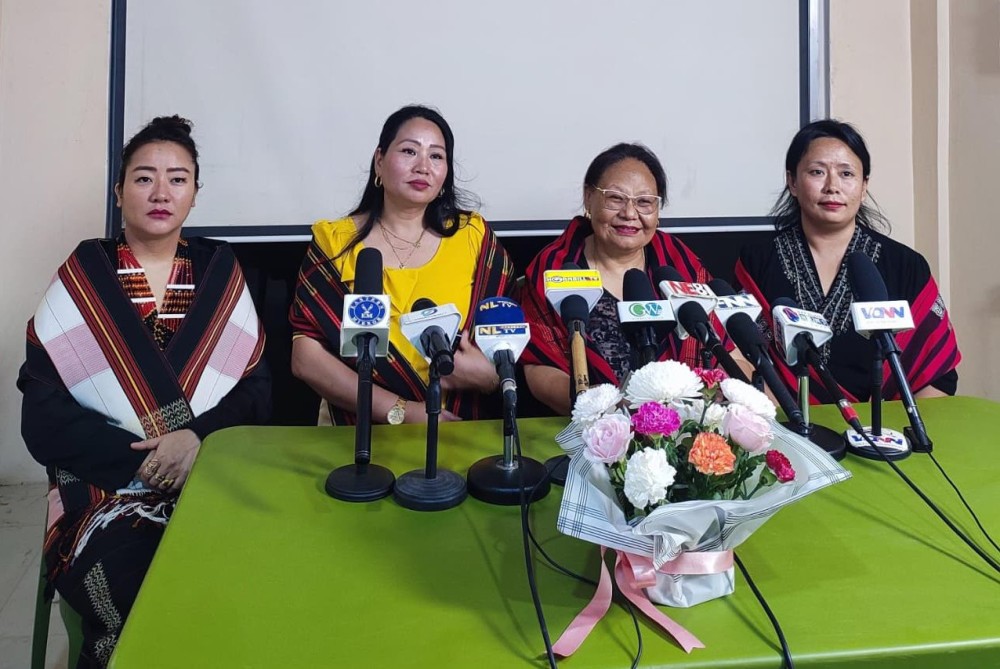
Tsachola Rothrong (second from right), President, Nagaland state BJP Mahila Morcha, at the press conference in Dimapur on April 13. (Morung Photo)
‘Guaranteed representation for Naga women, says state BJP Mahila Morcha
Morung Express News
Dimapur | April 13
Tsachola Rothrong, President of the Nagaland State Bharatiya Janata Party (BJP) Mahila Morcha, described the Nari Shakti Vandan (Women’s Reservation) Act, 2023, as a “historic milestone in India’s journey towards inclusive and participatory governance.”
The Women’s Reservation Act, also known as the Constitution (One Hundred and Sixth Amendment) Act, provides for reserving 33 percent of seats for women in the Lok Sabha, state legislative assemblies, including the Delhi Assembly. It also includes reserving one-third of the seats already reserved for Scheduled Castes and Scheduled Tribes for women. The provision has still to be applied in practice however.
Addressing a press conference, in Dimapur, on April 13, Rothrong stated that the law represents a decisive step in strengthening the country’s democratic foundations. According to her, there will be ‘delimitation’ of seats which potentially implies increase of seats, including Nagaland’s representation in the Lok Sabha. She added that the Prime Minister holds “full confidence” that enhancement of parliamentary representation will facilitate broader participation. Nagaland has only one seat in the Lok Sabha.
She said, “With the Nari Shakti Vandan Act, Naga women will now have constitutionally guaranteed representation in legislative governance,” opening a new chapter of leadership and policy influence for women in Nagaland.
Women’s participation in decision-making has traditionally been a touchy subject in Nagaland. The state had witnessed violent upheaval in 2017 over the same matter in connection to the Urban Local Bodies (ULBs). It culminated with the state government enacting the Nagaland Municipal Act, 2023, with 33 percent of seats in the ULBs reserved for women, and the subsequent holding of ULB elections with reserved seats in 2024.
Queried on the prospects of reconciling the new legal mandate with the Naga traditionalist approach to governance, she replied, “What you say is partially true. In the first place, the 33 percent reservation was already implemented in the ULBs. That was the first step, the breakthrough. So now, automatically, reservation in the state and parliament will come into effect.”
For the BJP, she claimed that women’s empowerment is a “governance priority” rather than an electoral narrative. She called upon educated women in Nagaland to enter the political sphere to ensure that the reserved quota is filled by capable leaders. “Politics is a risky game, but you should be brave enough to join the political parties and then take the risk so that you can utilise your education for the good of the people,” she said.
She added that women today are driving economic growth rather than mere beneficiaries. In higher education, she said that female enrollment has risen from 1.57 crore in 2014-15 to over 2.18 crore today.
The state Mahila Morcha further announced an all-female bike and scooty rallies, along with Padayatras, to be held across various districts on April 15. In Dimapur, the rally is scheduled to begin at 6:30 am from the DMC Office at Forest colony. This will be followed by “Mahila Sammelans” (women's conventions) on April 16. She said that the programme is aimed at taking the message of Nari Shakti directly to the people.
The Narendra Modi-led NDA government is targeting the implementation of the 2023 enactment by 2029, before the country goes to vote for the 2029 parliamentary polls. If the Women’s Reservation Act is implemented, followed by delimitation, the number of Lok Sabha seats is projected to increase to 816.