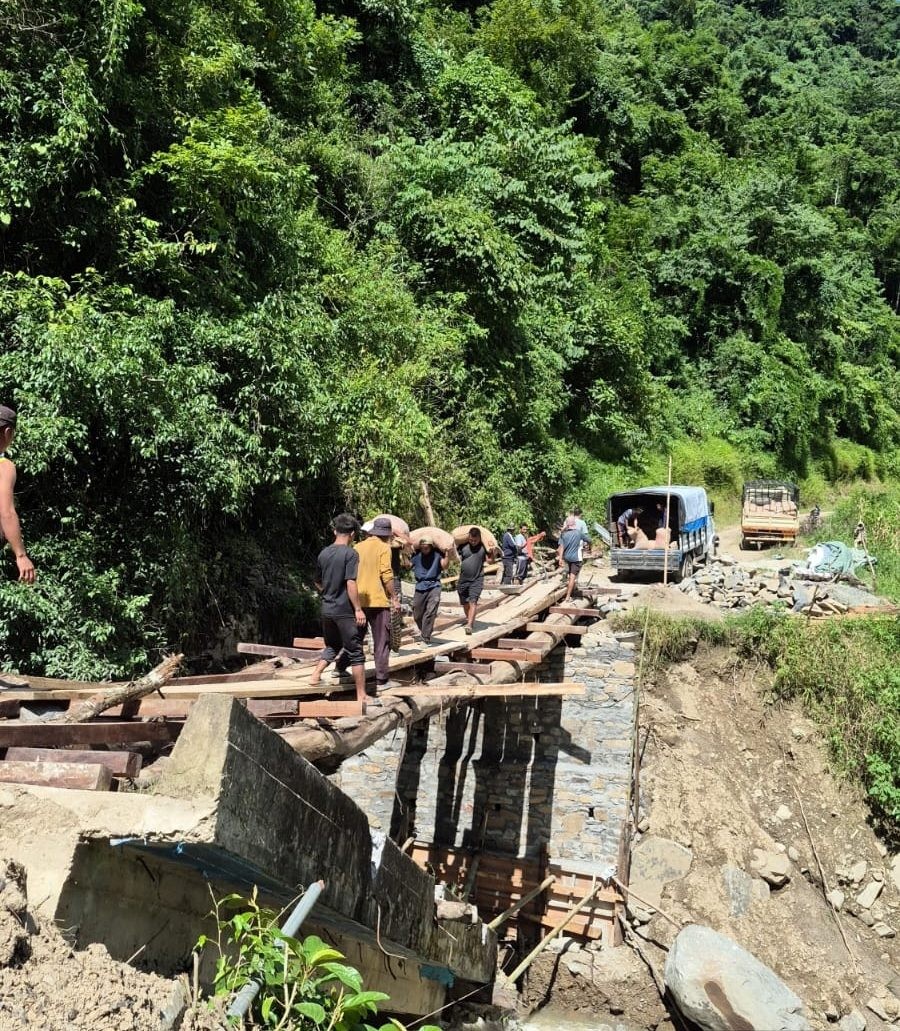
Villagers from Tsuwao and Lengnyu village carrying their essential supplies (rice) on foot to their villages. (Morung Photo)
Shongmo B
Noklak | September 7
Tsuwao and Lengnyu, two close neighbouring villages, are located about 7–8 kilometers from the headquarters of Noklak District. For the villagers, having a proper road not is a vital need. The Panso Circle in Noklak serves as a crucial link to connect these villages.
Before the severe landslide triggered by the heavy monsoon rains in July and August, reaching the villages was possible by road. Now, however, the road is gone. For many villagers, especially those in need of medicines, food, or other essentials, the journey begins on foot, with only the option of traveling by two-wheeler over difficult terrain.
A youth from Lengnyu village voiced concern over the lack of road connectivity. “We are habituated traveling on foot. But In this season many people fall ill or meet an accident, and there is no proper medical facilities available in the village, so reaching the hospital become extremely hard and challenging,” he told The Morung Express.
Highlighting the vulnerability of the most affected groups, he said that pregnant women, elderly people and children are at serious risk because there is no road connectivity between our village and the neighbouring town.
.webp)
“This issue needs to be looked into without delay. We don’t ask for luxury. But we are asking for a basic infrastructure that every citizen deserves,” he added.
A mother of nine children had to often travel on foot walking 3 to 4 hours to meet her children at the district, Noklak, who are settled for education and some of them doing other works. Sharing the hardships about her journey on foot, she said that carrying a bottle of water to quench her thirst is enough.
Sometimes, she would return the same day on foot with the most basic - Salt. “It is dangerous to walk alone and the journey is very tiring,” she said.
With essential supplies running out for over two months, shops in Lengnyu and Tsuwao villages are facing a severe shortage. Lengnyu, which has five shops, has seen one shut down, while Tsuwao is left with just three functional outlets.
A young shopkeeper in Lengnyu said even basic commodities like sugar, tea, salt and soap are now in short supply. Both villages are facing similar challenges, with commercial vehicles having stopped plying.
Agricultural products from the fields remain the support to their daily needs.
Local agricultural produce from the field has now emerged as the primary source of daily sustenance for residents in the region.
In a tragic incident from Tsuwao village, a mother of two lost her life while waiting to make the journey to district hospital, Noklak for proper treatment. According to a relative, the family was prevented from travelling due to a blockade. Before they could arrange an alternative or begin their journey, the woman’s condition deteriorated, and she passed away, leaving behind her two young children and a grieving family.
.webp)
A journey that never began
The disruption of road connectivity has severely affected access to essential healthcare services, highlighting the persistent vulnerability of the area’s transport infrastructure where timely medical aid remains a major concern.
A local youth from Tsuwao village pointed out that heavy motorcycle are unable to cross the temporary bridge that was constructed. “Only Burma bike is possible to pass through the bright since it is light and can carry heavy loads, yet it is not safe to pass through easily,” he said.
A massive landslide on July 19 washed away a key stretch of the Noklak–Tsuwao–Lengnyu PWD Road, cutting off road connectivity to nine villages, including Panso HQ, Pathso, Tsuwao, Yokao, Lengnyu, Ekhao, Lumoking (UR) and Tsangkue.
The Agri Link Road was also damaged, severely affecting access to agricultural areas. With vehicular movement now halted, villagers are forced to rely on bikes or travel on foot to reach Noklak headquarters. An alternative route exists but is longer, costlier and more time-consuming.
Amid the hardships, concerned departments have been reaching out to the affected villages.
In a testament to resilience and community solidarity, a team of doctors and health workers travelled on motorcycles, carrying medical supplies to Lengnyu village after road disruptions forced them to abandon their vehicles midway. The villagers, in turn, walked half the distance to receive the team and assist with the onward journey.
As for essentials commodities, with normal routes affected, the relief supply of rice transportation was arranged to ensure that essential food reaches the affected community on time. DDMA and department of Food and Civil Supply, Noklak, assisted the Lengnyu and Tsuwao villages in emergency rice transportation as road and bridge damaged by landslide and flash flood.
Road restoration work between Noklak-Panso was carried out for three days from July 22-24 under the supervision of DDMA along with PWD (R&B) and general public.
Restoration works to continue
The DDMA has informed that restoration work on the vital road link is currently underway. Light vehicles will be allowed to ply once the repairs are completed.
Until then, Lengnyu and Tsuwao villages remain cut off from the mainstream, their connectivity measured not in kilometres of motorable road, but in the distance villagers can cover on foot or, for a few, on two-wheelers where terrain permits.
Until the road is fully restored, the villagers will continue to walk through stretches where vehicles cannot pass and ride wherever the battered surface allows. While the stretch is only 7 kilometres on the map, the ground reality tells a different story—one of exhaustion, uncertainty, and above all yearning for the basics in a world where advancement is a trend.