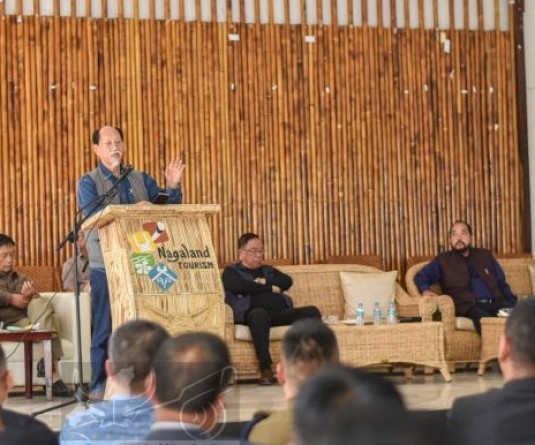
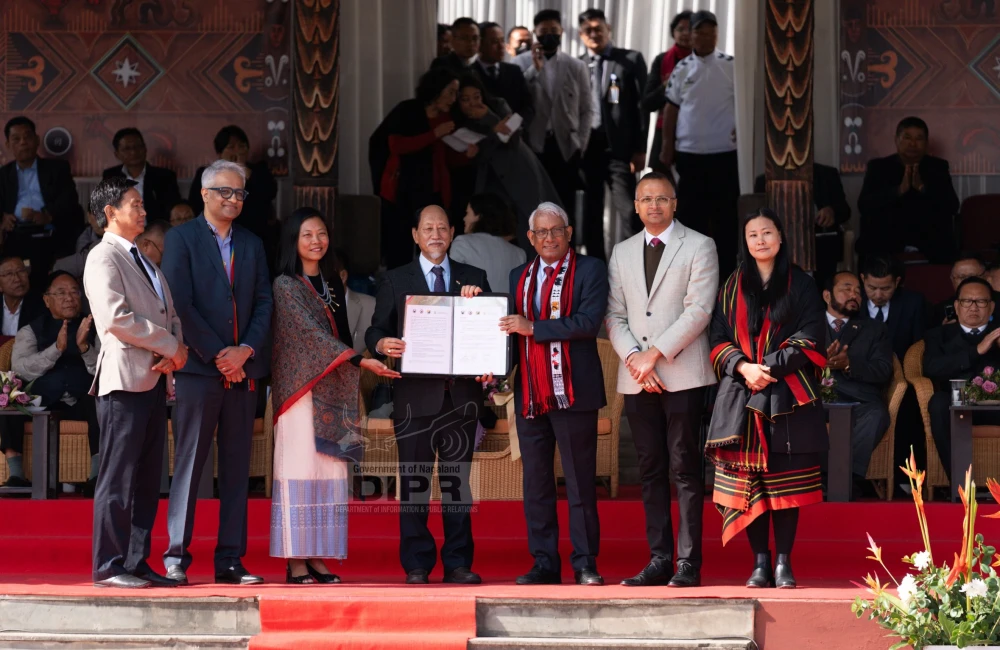
Dr. Neiphiu Rio launching the Nagaland Entrepreneurship Impact Forward 2035 under Industries & Commerce Department.
Our Correspondent
Kohima | December 1
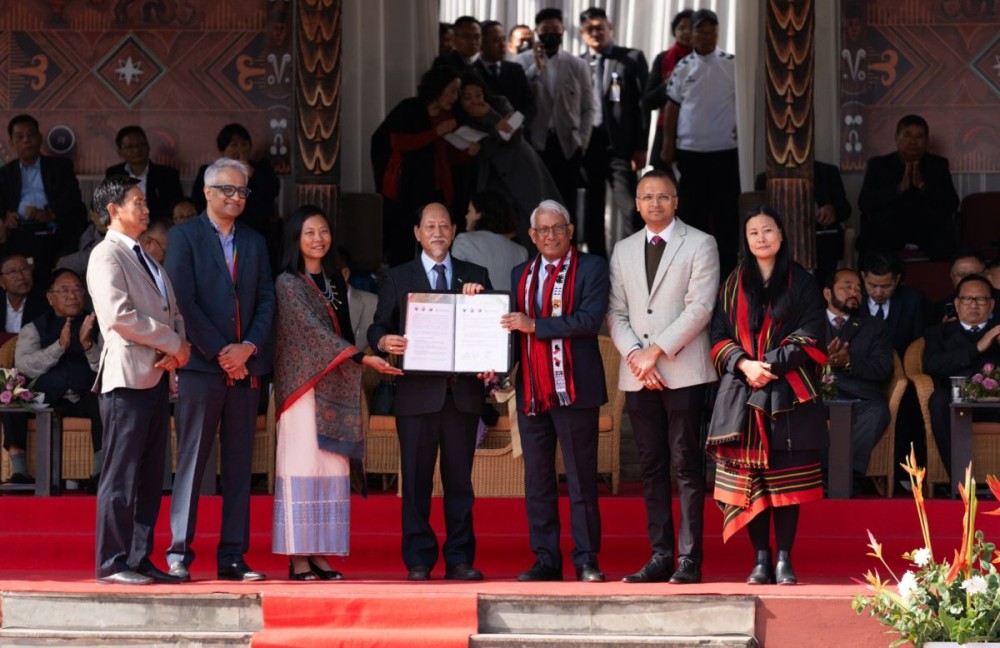
Nagaland Chief Minister Dr Neiphiu Rio today highlighted the state’s developmental achievements on the occasion of the 63rd Statehood Day celebration in Kohima.
Dr Rio said Nagaland’s population is significantly youthful, with about 22% aged 15 to 25 years. To nurture talent and excellence in sports, 31 multidisciplinary indoor stadiums and 28 futsal grounds have been sanctioned across districts. Additionally, the government will allocate Rs 3 lakh per Assembly Constituency from LADP 2025-26 onwards as a “District Sports Fund.”
In higher education, 129 new Assistant Professor posts have been created in Arts, Science, and Commerce under the Department of Higher Education to meet national standards. Four new Model Degree Colleges in Niuland, Shamator, Noklak, and Tseminyu have also been approved to expand access to quality higher education. The PM-USHA Centrally Sponsored Scheme is being implemented to upgrade infrastructure in government colleges.
Dr Rio said the NEP 2020-based curriculum will be implemented in technical education from the 2025-26 academic session. The forthcoming Nagaland Technical Education Policy (NTEP) aims to transform the sector through mission-mode reforms.
To safeguard job seekers, the state notified a Regulatory Framework for Private Placement Agencies on May 31, 2025. The Nagaland Trade Investment & Industrial Policy (NTIIP), 2025, aims to strengthen the industrial ecosystem, encourage entrepreneurship, generate employment, and boost the economy. Through the Chief Minister’s Corpus Fund, financial assistance was provided to 184 entrepreneurs last year and 191 beneficiaries this year.
The Information Technology and Communication Department has initiated the Nagaland Innovation Hub for startups at Chumoukedima. Under the NECTAR Project supported by the World Bank, Light House School Complexes are being constructed in 16 districts, with 35% progress completed. A pilot music education project is underway in 40 elementary schools in Kohima and Dimapur in partnership with Yamaha Music India Pvt Ltd.
On infrastructure, 75.20 km of road under PMJSY and 17.16 km under NESIDS have been completed. Widening and strengthening of 68.6 km of NH-61 and improvement works on 32 km of NH-702A have also been completed. Air connectivity plans include four STOL-capable landing strips at Ciethu, Kohima, Mokokchung, Mon, and Tuensang. Three water bodies—Noune, Shilloi, and Doyang—have been selected as inland waterway corridors, with a revised proposal for Tizu-Zungki River submitted to the IWAI.
Power infrastructure has been strengthened with the upgrade of Nagarjan Substation, Dimapur to 350 MVA and construction of a 220/132/33 kV substation at Tsitrongse (Diezephe). A comprehensive transmission plan with the CEA aims to meet the projected load of 304 MW by 2035.
-book.webp)
Health initiatives include achieving zero malaria cases in seven districts and recognition of the Chief Minister’s Health Insurance Scheme with the 2024 Innovation Award by the Centre for Innovations in Public Systems. A 400-bedded Medical College Hospital at NIMSR, Kohima is underway with JICA support.
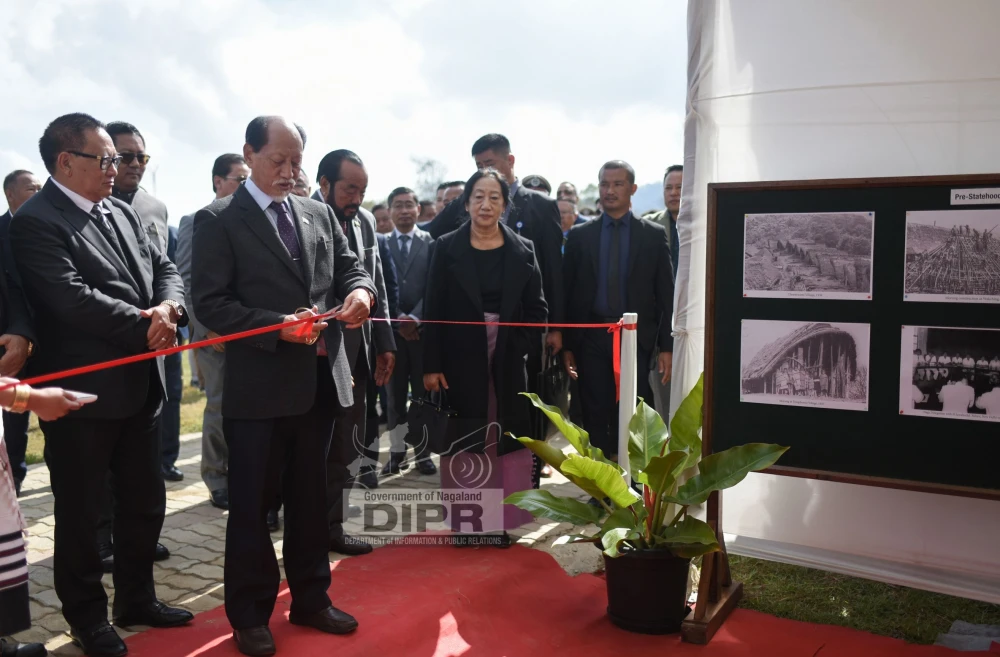
Urbanisation continues to grow, with 28.86% of the population in urban areas as per 2011 census. Kohima saw the inauguration of the Peace Memorial and Eco-Park complex at Officers Hill on November 29, 2025. The state is also planning “Nagaki City” at Chathe Valley, Chumoukedima, aimed at promoting innovation, entrepreneurship, and youth empowerment.
Agriculture and allied sectors saw significant development, with 30,500 ha under organic cultivation benefiting 31,104 farmers. MoUs have been signed for jute and allied fibres development.
Horticulture, sericulture, and fisheries programs have expanded, benefiting hundreds of farmers. Nagaland is emerging as a leading coffee-producing state, exporting to South Africa, the EU, the Middle East, and other countries.
-on-Traditional-Attires-and-Ornaments-of-10-indigenous-Tribes.webp)
Rural livelihoods continue to be strengthened through NSRLM, mobilising over 1.36 lakh households into 15,434 SHGs. The Lakpati Didi Vision includes 30,000 SHG women members contributing towards “Vikshit Bharat@2047.” Under MGNREGA 2025-26, 2.59 lakh rural households received work, with nearly 50% of person-days generated by women.
Underdeveloped areas are being developed through UDAP and Vibrant Village Programme (VVP-II), focusing on self-reliance, community engagement, and national integration. The Konyak Heritage Complex in Mon district is a key cultural initiative under DUDA, supported by NEC, Ministry of DoNER.