DTF Meeting on Immunization and NVBDCP.
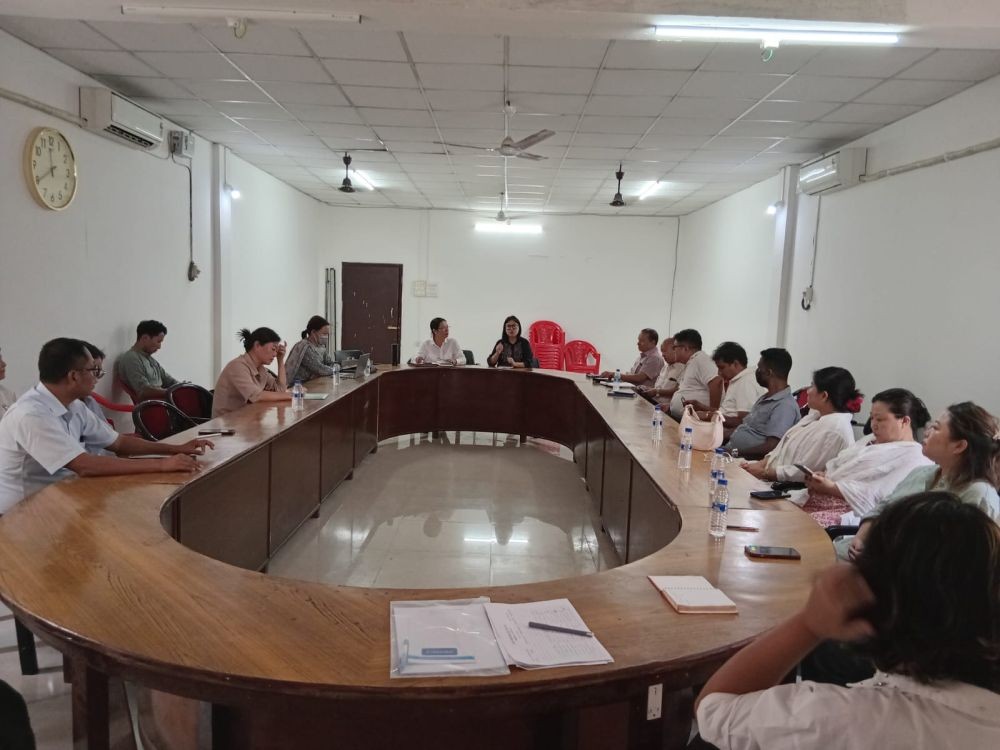
DIMAPUR, JUNE 12 (MExN): The District Task Force for Immunization and National Vector Borne Disease Control Programme (NVBDCP) review meeting was held at the Deputy Commissioner's Office Conference Hall, Dimapur, on June 12.
Chairing the meeting, EAC Dimapur Imlijungla stressed the need for effective coordination and convergence among departments to ensure the smooth implementation of health programmes in the district.
Presenting an update on immunisation activities, WHO Surveillance Medical Officer Dr Sheila Longkumer said India continues to maintain its polio-free status, but vigilance remains necessary as Pakistan and Afghanistan continue to report cases of wild poliovirus.
Referring to the nationwide polio campaign conducted in March 2024, she informed the meeting that Dimapur recorded its highest-ever coverage, with 76,133 children vaccinated. She outlined the implementation strategy for the Intensified Pulse Polio Immunisation (IPPI) programme scheduled for June 28, stating that "Booth Day" will be observed on Sunday, followed by house-to-house visits on Monday and Tuesday.
"It must be clearly understood that house-to-house teams alone cannot achieve 100 percent coverage," she said, urging parents and guardians to bring all children aged between zero and five years to vaccination booths.
Dr Longkumer also sought support from the Education Department, schools, teachers, ASHAs, Anganwadi workers and local authorities for community mobilisation and awareness activities.
On the measles situation in the district, she informed the meeting that the Health Department is responding to an outbreak that began in Purana Bazaar and has spread to adjoining colonies. More than 40 children between two months and 14 years of age have been affected so far, with the majority found to be unvaccinated.
Given Dimapur's large urban population and continuous influx of migrants, the district has been classified as high-risk, she said. The response plan includes detailed case investigations and intensive house-to-house vaccination drives. She added that a Measles-Rubella campaign is also being planned, during which an additional dose of the vaccine will be administered to children.
District Programme Officer (RCH/UIP) Dr Rongsennungla highlighted the district's cold chain management system, stating that vaccines are stored at prescribed temperatures and monitored online round the clock to maintain potency. She informed the meeting that Dimapur currently has 12 functional cold chain points.
She further noted that under the Intensified Diarrhoea Control Fortnight (IDCF) campaign, scheduled from June 16 to July 31, ORS-Zinc corners have been established, ORS packets are being distributed by ASHAs, and awareness activities on handwashing and safe drinking water are being conducted.
Project Officer, UNDP, Rajesh Monsang spoke on HPV vaccination and cervical cancer prevention. He said cervical cancer remains the fourth most common cancer globally and the second most common among women in India, while also being highly prevalent in Nagaland.
He informed the meeting that HPV vaccination was introduced into India's routine immunisation programme this year and that the vaccine offers the greatest protection when administered to girls aged 14 years before exposure to the virus. Under the government programme, the vaccine is provided free of cost up to the age of 14 years.
With support from the District Education Officer, he said, a three-month additional HPV vaccination campaign has been launched. India has also adopted a single-dose schedule, in line with several other countries, to improve coverage and compliance.
NVBDCP Consultant Heanglih T Konyak presented an overview of the programme's performance and said the national goal is to eliminate malaria by 2030. Dimapur, she added, is targeting malaria elimination by 2027 and aims to achieve zero indigenous positive cases.
She emphasised that strong surveillance, early detection and timely treatment remain critical to achieving the target. Community participation through source reduction, regular use of bed nets and early reporting of fever cases was also highlighted as essential.
District Programme Officer (CD-I) Dr Avangla Saku informed the meeting that health workers upload daily fever surveillance reports online, enabling continuous monitoring and timely interventions.
In her concluding remarks, Imlijungla urged all allied departments to work in close coordination and extend mutual cooperation for the effective implementation of health programmes. She also encouraged departments to seek any necessary administrative support to ensure smooth execution of activities on the ground.
The meeting was attended by the Chief Medical Officer, Deputy Chief Medical Officer, District Education Officer, representatives from the Muslim and Jain communities, and staff of the Chief Medical Officer's Office, Dimapur.