Participants of the Gender sensitisation workshop in Dimapur.
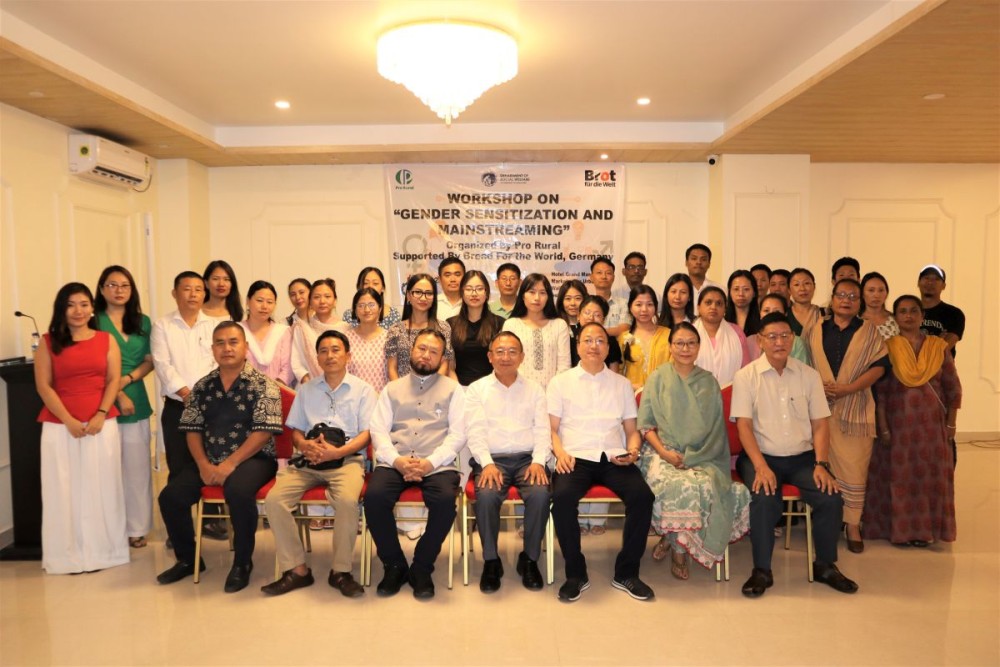
Dimapur, May 29 (MExN): Speakers at a gender sensitisation workshop in Dimapur on Friday stressed that achieving gender equality requires more than policy discussions, calling for deeper changes in social attitudes, cultural stereotypes and participation in decision-making processes.
The one-day workshop on ‘Gender Sensitisation and Mainstreaming,’ organised by PRO RURAL at Hotel Grand Maspel, brought together representatives from government departments, church forums, educational institutions, universities, student bodies, civil society organisations and NGOs to deliberate on issues related to gender equality, inclusion and women’s rights.
According to a press release, the programme aimed to strengthen awareness and understanding of gender issues while promoting equal opportunities, respect and inclusive development across society.
Delivering the first technical session on ‘Gender Sensitisation: Building Respect and Equal Opportunity,’ Akokla Longchar, former member of the Nagaland State Commission for Women, said gender roles are socially constructed and often reinforced through stereotypes and exclusionary practices.
She highlighted concepts such as gender equality, gender equity, discrimination, respect and inclusion, while stressing the need to create safe and inclusive spaces for all individuals. She also underscored the importance of women’s participation in leadership and decision-making processes.
The session examined misconceptions surrounding gender norms and challenged the idea that certain responsibilities are exclusively masculine or feminine. Longchar also highlighted the contributions of women in family welfare, education, economic activities and community development.
The second session on ‘Traditional Concepts and Practices of Gender Equality among the Nagas’ was presented by Rev Fr G L Khing, Vice-Principal of North East Institute of Social Sciences and Research. He shared insights into traditional Naga social structures and evolving cultural practices related to gender roles and responsibilities.
In another session, Ikali Wokhami, District Mission Coordinator of Mission Shakti, spoke on domestic violence against women and children, highlighting different forms of abuse, its impact on victims and families, and available legal protections and support systems.
The final technical session was delivered by Dominic K Khamyo, Principal of Eastern College, who highlighted the importance of women’s empowerment and active participation in social, economic and developmental processes.
The workshop concluded with a panel discussion and interactive session where participants discussed practical challenges related to discrimination, gender-based violence, women’s representation in leadership and strategies for promoting inclusive development.