Officials and stake holders at the meeting held at ICAR, Nagaland Centre Medziphema on June 12.
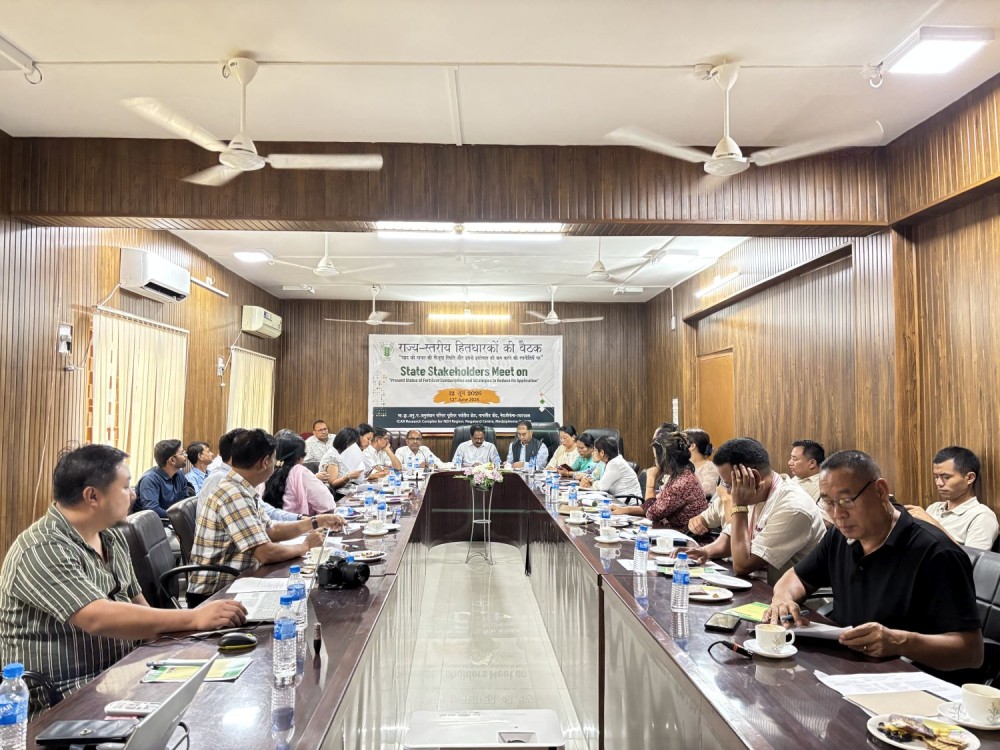
Medziphema, June 12 (MExN): The ICAR Research Complex for NEH Region, Nagaland Centre, Medziphema, organised a state stakeholders’ meeting on ‘Present Status of Fertilizer Consumption and Strategies to Reduce its Application’ on June 12, bringing together policymakers, scientists, academicians, extension personnel and development agencies to deliberate on improving nutrient-use efficiency and promoting sustainable agriculture in Nagaland.
The programme was attended by Joint Secretary, Department of Agriculture, Limanenla; Director of Agriculture, Sanuzo Neinu; Director, ICAR-NRC on Mithun, Girish Patel; Dean, College of Veterinary Sciences and Animal Husbandry (CoVS&AH), I Shakuntala Devi; Dean, School of Agricultural Sciences, Nagaland University, Pauline Alila; Joint Director, Directorate of Agriculture, Rosemary Ezung, along with scientists, Krishi Vigyan Kendra (KVK) heads, state agriculture officials and representatives from line departments.
Welcoming the participants, Head of Regional Centre, ICAR Research Complex for NEH Region, Nagaland Centre, H Kalita highlighted the importance of balanced and judicious fertilizer use for sustaining agricultural productivity, improving soil health and protecting the environment. He stressed the need for Integrated Nutrient Management (INM) through the combined use of chemical fertilizers, organic manures and bio-fertilizers, while calling for greater collaboration among research institutions, extension agencies, government departments and farmers.
In his opening remarks, Sanuzo Neinu underscored the importance of improving nutrient-use efficiency to ensure long-term food security, soil health and farm profitability. He called for science-based interventions, increased farmer awareness and coordinated stakeholder efforts to promote sustainable nutrient management across the state.
A key feature of the meeting was the presentation of the Draft State Action Plan on Fertilizer Consumption and Reduction Strategies by Head of ICAR-KVK Kiphire, Lahar J Bordoloi. The proposed roadmap focuses on promoting soil test-based nutrient application, Integrated Nutrient Management, Integrated Farming Systems (IFS), production and use of bio-fertilizers, bio-inputs and Azolla, natural farming, cultivation of less nutrient-intensive crops and precision farming technologies.
The draft plan also proposes the development of a Decision Support System (DSS) for site-specific and need-based nutrient application, alongside capacity building of farmers and strengthening extension services to accelerate the adoption of sustainable nutrient management practices.
The presentation was followed by an interactive discussion during which stakeholders shared recommendations on improving nutrient-use efficiency, strengthening soil health management, promoting climate-resilient agriculture and ensuring effective implementation of the proposed interventions.
During the discussion, Girish Patel emphasised the importance of integrated farming approaches in Nagaland’s hill ecosystems and the balanced use of fertilizers. He highlighted the role of livestock in nutrient recycling and sustainable agriculture, noting that integrating crop and livestock enterprises could significantly reduce dependence on external fertilizer inputs while improving farm income and resource-use efficiency.
I Shakuntala Devi underscored the importance of strengthening crop-livestock integration and promoting organic nutrient sources derived from animal husbandry systems. She highlighted the potential of livestock-based farming systems in enhancing soil fertility, supporting circular nutrient flows and contributing to environmentally sustainable agricultural development.