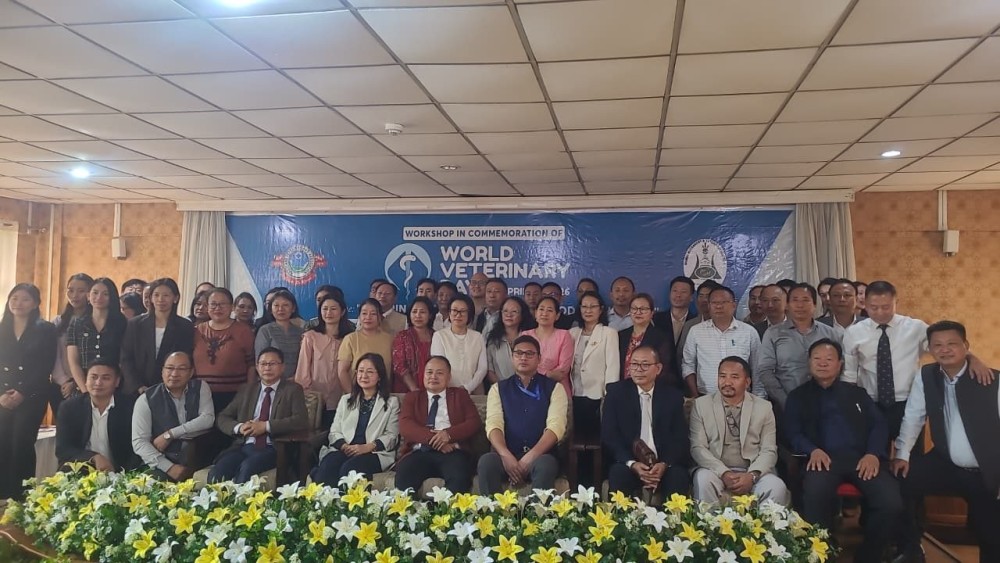
Dignitaries and others during World Veterinary Day in Kohima on April 25. (Morung Photo)
Our Correspondent
Kohima | April 25
The Nagaland Veterinarian’s Association (NVA) with the support of the Department of Animal Husbandry & Veterinary Services, Nagaland, organised a workshop in commemoration of World Veterinary Day at Hotel De Oriental Grand, Kohima on April 25.
Gracing the occasion as the special guest, Anjelina Tajen, Secretary, Animal Husbandry & Veterinary Services & Tribal Affairs, Government of Nagaland maintained that veterinarians are guarding the public health. “Your vaccination drives in border areas, your One Health approach, your surveillance of zoonotic diseases are public health acts. When you vaccinate a dog or test a pig, you are vaccinating and protecting a family,” she said.
She said that the veterinarians interventions in certifying the meat at slaughter houses, fighting ASF and avian influenza, will ensure that the food chain is not contaminated.
Touching on the need for streamlining and filling vacant posts, Tajen also called for ensuring mobile Veterinary units in every district, cold-chain for vaccines, upgrading infrastructure in all QCPS & digital tools for disease reporting.
“The Government’s commitment under NLM & the state’s own schemes must be matched by timely resources and training,” she said adding that a future-ready Nagaland needs a future-ready veterinary service.
Stating that climate change will shift disease patterns, she said, “Consumers will demand safer, traceable food. The Government will expect “One Health” delivery, not just animal treatment.”
She urged the veterinarians to be the guardian who constantly evolves and also told them to learn new skill and adopt new technology. “Animals cannot vote. They cannot lobby. They cannot say, “thank you”. But because of you, a child drinks safe milk today. Because of you, a family income survived. Because of you, the word ‘epidemic’ was contained instead of a headline,” Tajen said.
World economy depends on animal health sector
Dr Zasekuolie Chusi, Commissioner & Secretary for Department of Land revenue, Tourism and Director of Census Operations, termed the veterinary profession as “very challenging” and called upon the veterinarians to introspect and retrospect of what they are and what they are doing.
“We need to do or we need to go for extra miles. Are we doing justice to our profession? Are we doing justice to our service?,” he said while addressing the inaugural session as guest of honour.
Dr Chusi subscribed the veterinary profession as a big challenge for strengthening the rural economy, adding that the world economy depends on animal health sector.
Stating that the department is improving in many aspects, he urged upon the veterinarians to go extra mile as “the rural economy depends upon our profession.” We also need to generate some income for the state, he said.
‘Veterinarians safeguard human health, food security’
NVA President Dr KN Zubemo Humtsoe said that veterinarians play in safeguarding not only animal well-being but also human health, food security, and the sustainability of environment. “We are the silent guardians who ensure that the food reaching our tables is safe, nutritious, and free from disease. From farms to markets, from laboratories to remote rural communities, our presence is indispensable,” he said. Veterinarians work tirelessly to monitor animal health, prevent disease outbreaks, and ensure hygienic practices in food production systems, he added.
Dr Humtsoe said that veterinarians play a crucial role in supporting farmers and strengthening rural economy, maintaining that healthy livestock leads to increased productivity, improved livelihoods, and enhanced food security.
Stating that veterinarians also play as protectors of public health, he said that veterinarians serve on the frontlines in identifying, controlling, and preventing These zoonotic diseases, such as rabies, avian influenza, and others pose serious threats to global health.. He said that the recent global health challenges have further emphasized the importance of the One Health approach, which recognizes that human health, animal health, and environmental health are interconnected.
Stating that wildlife conservation is another area where veterinarians make remarkable contributions, he said, “We work to protect endangered species, rehabilitate injured animals, and preserve biodiversity.” Adding that veterinarians often work under challenging conditions, especially in remote and underserved areas, he stressed on the need to support them through better infrastructure, access to modern technology, continuous training, and fair opportunities.
‘Ensure DPRs are designed to be environmental friendly’
Dr Kuokehebi Gwirie, Director, Animal Husbandry & Veterinary Services, Nagaland, said that this year theme aim to elevate public awareness and policy recognition of veterinary profession as a cornerstone of secure and sustainable food systems. “Form Farm to Fork, veterinarians are the frontline of ensuring that food of animal origin is safe, nutritious and responsibly produced,” Dr Gwirie said.
Stressing on the need to retrospect the activities on real-time basis, he said, “The need of the hour is to have a realistic target setting, upgrade disease diagnostic facilities and quality checking facilities.” Further, he urged to ensure that DPRs are designed to be environmental friendly and towards meeting the Sustainable Development Goal (SDG) indexes.
Nagaland produces most hygienic pork in India
“We now do rearing crossbred pigs and Nagaland happens to be the most hygienic pork producers in India. Our rearing system has improved to such an extent,” said Dr Simon Ao, president Nagaland State Veterinary Council. He said the state managed to introduce dairy cows and the farmers are now are rearing dairy cows and accordingly milk has been made available. Hygienic milk is now made available in the market under the banner of the Nagaland State Dairy Cooperative Federation.
Touching on and public health and food safety, he stressed on the need to design and develop and regulate a strong inspection system in the state. He assured that NSVC will always be there to support and upgrade the standards of “your professional efficiency” and conduct training time to time.
Later, Dr Raghubir Singh, Assistant Professor, Department of Veterinary Public Health & Epidemiology College of Veterinary Science & AH Jalukie acted as the theme speaker of the workshop session. Dr Tolto Metha and Dr H Inato Jimomi led the inaugural and workshop session respectively while vote of thanks was proposed by Dr Vikuolie Mezhatsu.