Officials during the orientation programme for members of the Financial Committees of the NLA held at the K Shikhu Conference Hall of the NLA Secretariat in Kohima on June 5. (DIPR Photo)
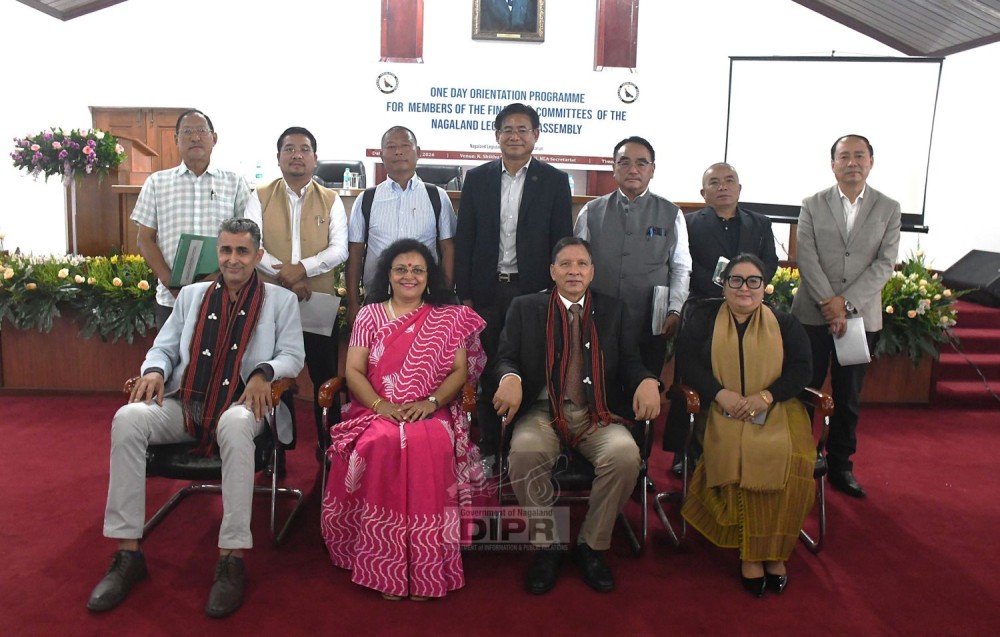
Kohima, June 7 (MExN): A one-day orientation programme for members of the Financial Committees of the Nagaland Legislative Assembly (NLA) was held at the K Shikhu Conference Hall of the NLA Secretariat on June 5, focusing on legislative oversight, public expenditure monitoring and financial accountability.
According to a DIPR update, former Additional Secretary of the Lok Sabha Secretariat, Devender Singh, who served as the resource person, delivered detailed presentations on the mandate, powers, procedures, responsibilities and limitations of the Public Accounts Committee (PAC), Estimates Committee (EC) and Committee on Public Undertakings (COPU).
He emphasised that parliamentary oversight of public expenditure extends beyond approving government spending and includes ensuring that funds are utilised prudently, efficiently and in accordance with legislative approval. Such oversight, he said, is essential for maintaining accountability of the executive to the legislature.
Explaining the functions of the committees, Singh said the PAC examines appropriation and finance accounts, Comptroller and Auditor General (CAG) reports and instances of expenditure to ensure financial discipline and compliance with approved allocations.
The Estimates Committee, he said, is tasked with identifying economies, administrative reforms and improvements in efficiency, while suggesting alternative policies to enhance government functioning. COPU, on the other hand, scrutinises the performance, autonomy and efficiency of public undertakings.
Officer on Special Duty (Budget) in the Finance Department, Ketoulhou Metha, presented an overview of the state's financial architecture, scheme implementation mechanisms, fund flow systems, Centrally Sponsored Schemes (CSS), the Public Financial Management System (PFMS) and procedural irregularities in implementation.
Metha outlined the state's financial position and budget allocation process, describing PFMS as an effective tool introduced by the Union Finance Ministry to monitor and track the flow of public funds. He expressed concern over the failure of many departments to submit monthly reconciliation bills, which he said often leads to erroneous accounting entries.
Senior Deputy Accountant General Kahoto J Yepthomi of the Indian Audit and Accounts Service (IA&AS) spoke on the audit mandate of the Comptroller and Auditor General, audit reporting procedures and departmental compliance mechanisms.
He explained that audits are conducted annually, particularly in departments classified as high-risk, including police, education and health. Audit observations are issued where departmental responses are found unsatisfactory, he said.
Yepthomi also observed that fraudulent withdrawals at the end of financial years had become a recurring issue in some government departments.
The programme included an interactive question-and-answer session during which members sought clarifications on practical issues from the resource persons, including Deputy Secretary of the Lok Sabha Secretariat Malvika Mehta and Deputy Director of the Parliamentary Research and Training Institute for Democracies (PRIDE), Jitender Kumar.
Among those present were PAC Chairman and Advisor for Agriculture, Mhathung Yanthan; COPU Chairman and Advisor for Water Resources, Tongpang Ozukum; Advisor for Labour, Employment and Skill Development and Excise, Moatoshi Longkumer; Advisor for School Education, Dr Kekhrielhoulie Yhome; Advisor for Urban Development and Municipal Affairs, Zhaleo Rio; Advisor for NSDMA and Inland Waterways, Z Nyusietho Nyuthe; Advisor for Land Resources, G Ikuto Zhimomi; Advisor for SCERT and Food Processing, Achumbemo Kikon; and MLA Neisato Mero.
NLA Secretary Khruohituonuo Rio delivered the welcome address and formally inaugurated the programme, while Joint Secretary Darhu Shupao proposed the vote of thanks.