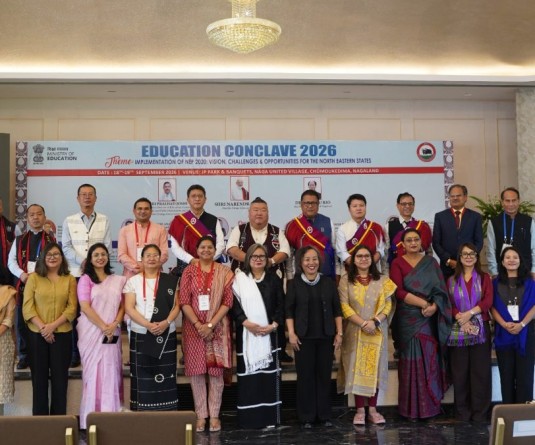
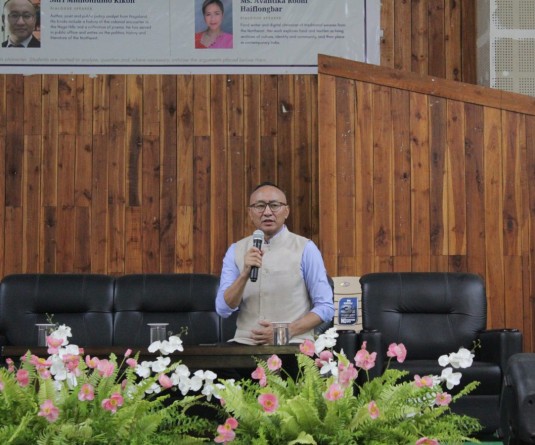
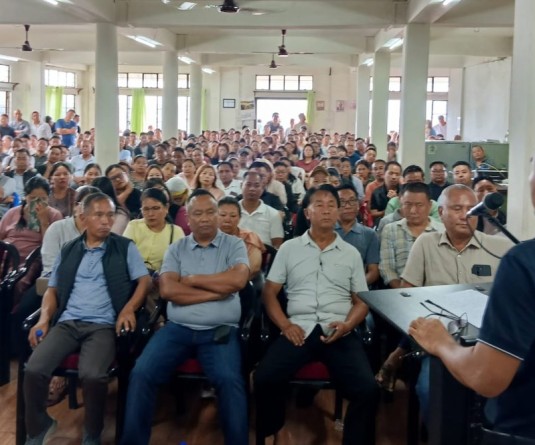
Prof Dolly Kikon with the participants and others during the screening of ‘A Sacred Place’ (2026) at the Conference Hall, Nagaland House, RK Puram, New Delhi on September 15. (Photo Courtesy: NSA)
Filmmaker discusses ethics of indigenous storytelling
New Delhi, September 18 (MExN): The Naga Scholars Association (NSA) organised a screening of the documentary film ‘A Sacred Place’ (2026), directed by Prof Dolly Kikon, at the Conference Hall, Nagaland House, RK Puram, New Delhi on September 15.
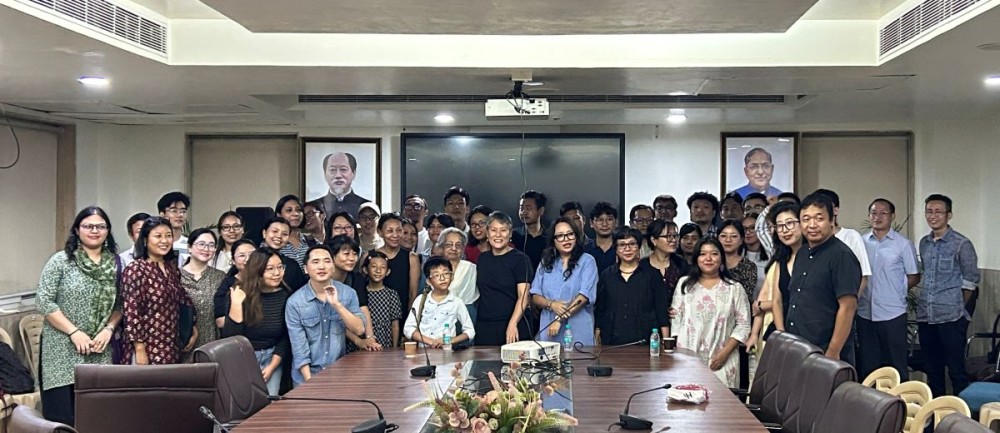
The programme brought together academicians, scholars, students, activists, student leaders, representatives of Naga organisations, and members of the wider community from within and beyond Naga society, the NSA stated in a press release.
Prof Kikon was invited for the screening and a subsequent discussion. The event was attended by her husband, Prof Sanjay Barbora, alongside prominent academics and public intellectuals, including Urvashi Butalia, Prof Sonajharia Minz, historian and filmmaker Uma Chakravarti, Prof Yaruingam Awungshi, Prof Zuchamo Yanthan, Dr Veio Pou, Dr Achingliu, and others.
Delivering the welcome address NSA President Dr Kharingpam Ahum Chahongnao underlined the significance of Kikon’s scholarly and creative engagement with indigenous histories, cultural practices, knowledge systems, and the complex relationships between communities, memory, and landscape.
Following the screening, an interactive discussion with Kikon was moderated by Nzanmongi (Jasmine) Patton, Associate Professor at Gargi College, University of Delhi. The discussion engaged with questions surrounding indigenous epistemology, spatiality, knowledge production, documentary methodology, and the politics of representation.
Participants raised questions concerning the role of the researcher or filmmaker in selecting and framing narratives, the implications of personal choices in storytelling, and the longstanding tension between romanticisation and claims of authenticity in representations of indigenous societies.
Responding to these questions, Kikon emphasised that indigenous knowledge should not be approached as a static historical archive or a culturally frozen inheritance. She characterised indigenous culture as living, relational, and continuously evolving. From this perspective, knowledge cannot be reduced to written texts or formally documented historical records, as it is also embedded in songs, poems, oral traditions, land, landscapes, the environment, everyday practices, and the various ways through which communities interpret and inhabit their world.
Kikon further reflected on the ethical dimensions of her documentary practice, highlighting the significance of respecting personal and community spaces. She stressed the importance of obtaining the consent of villagers before incorporating their stories, images and experiences into a documentary, and noted the responsibility of the researcher or filmmaker to communicate clearly to the community the nature of the work, its intended purpose, and the manner in which the documented material will be used.
The discussion also addressed the question of narrative framing. Kikon acknowledged that documentary-making necessarily involves choices regarding what is included, excluded, emphasised, or placed within a particular narrative framework. Such choices, she observed, are never entirely neutral but always political in one form or another.
Reflecting on the relationship between writing and visual storytelling, Kikon spoke of the distinctive possibilities offered by visual art and cinema, noting that visual storytelling possesses the capacity to communicate affective, spatial, and experiential dimensions of a narrative in ways that may not be fully captured through written texts alone.
In seeking to maintain the documentary's authenticity, Kikon explained that she consciously avoided imposing an external voiceover upon the narrative, allowing the villagers themselves to articulate and narrate their experiences. The participation of both younger and older members of the community further enabled the documentary to accommodate intergenerational perspectives.
The nearly hour-long interaction generated a lively and intellectually engaging exchange between Prof Kikon and the participants. Beyond its function as a film screening, the programme provided a significant platform for reflecting upon indigenous knowledge, cultural memory, ethical documentation, and the politics of representation.