We live at an age where conflict defines every waking moment in our lives. We wake up every day to news of ongoing wars, genocides, and new viruses which threaten to outscale the notoriety of those which we have once overcome. It is during a time such as this that humanity’s greatest strength has an opportunity to shine through – the capacity to adapt and show unity through our communities – yet, it does not. Despite being universally connected through globalisation and the widespread access to social media, we seem more disconnected than ever.
This time, we will focus on India and its overwhelming prejudice towards its own queer people. After all, the queer movement in India is a crucial group of individuals. As a result of India’s overwhelming population – being regarded as the country with the highest population in the world – even a percentage of 2% of the population identifying themselves as LGBTQ+ makes up 20 million people, and this only accounts for the people who are brave enough to allow themselves to be recognised. Due to the social stigmatisation of queer people worldwide – and especially in countries such as India – and hatred caused by several forms of queerphobia, many people are afraid of being recognised as queer by society, or are even turned away from exploring such a notion.
A significant reason for this is the publicly perceived “unnatural” nature of queer relationships or people. Any words associated with such a topic are seen as taboo due to the lack of social acceptance or are treated as a joke. The word “gay” is still used as more of a joke than for its accurate description, even in the current day. The lack of normalisation creates a hole which only digs itself deeper, as the pervading perception of these topics as taboo leads to people discussing any such ideas only in hushed whispers or behind closed doors, with no way for them to ever be discussed openly. Why should people be forced to bottle up their identities and relationships when there is nothing wrong with them?
How is this mindset of labelling normal topics as taboo perpetuated? One of the leading factors is the lack of sexuality education worldwide. Even today, many schools are reluctant to have students educated on such topics so that they may grow up to be aware of sexual identities, the dynamics of orientation, and many other topics. This is without mentioning that this is only one of the problems which the lack of sexuality education contributes to. Teen pregnancies, the transmission of STIs, and the perpetuation of sexual abuse are all societal problems which could be mitigated through the education of all people in schools. Yet, as of right now, schools still refuse to create a safer future for the next generation.
Sexuality education is how people come to be aware of many topics which society would otherwise be unwilling to elucidate them on. However, society, too, must change through the normalisation of queer identities. After all, it is as normal as a heterosexual relationship, only that the latter is more normalised due to the widespread media representation in the news and media. In this century, we have begun to witness an incline of queer representation in television shows, movies, and many other forms of media. Previously, these would only come in works such as Fire (1969), which faced intense backlash due to the portrayal of a same-sex relationship. Right now, the appearance of queer identities in forms of media is becoming more commonplace and normalised, yet still receives intense criticism only due to containing such portrayals. The mass public continues to view these relationships and identities as radical, even though said radicality is only, once again, a construct formed by social stigmatisation, despite all these elements being as normal as any other.
The endorsement of all of these elements is not for the special empowerment of queer groups, or to give them any rights which are not already present in society. The reason why many argue for these practices and the normalisation of elements such as same-sex relationships or fluid identities is to simply allow them to have the same rights which are already present for cisgender people or heteronormative relationships. It is not a fight or asking for something special, but simply to be treated the same way everybody else is. The existence of pride months is in order to recognise the effort which many went through to reach the state of acceptance which queer people have today, and also in hopes that they can be treated with the same love and kindness which anybody else receives.
The stigmatisation and hatred towards queer communities are simply one of the many examples of how the divisiveness of our society leaves us incapable of uniting for a greater purpose. Like with racism, classism, and ableism, we must work to eliminate any form of prejudice in our society to be able to properly show affection to our fellow people and neighbours. We must write down our love to cover up the inkstains of hate, as the sooner we accept the differences in the people around us and accept the humanity within each other, the sooner we can turn our attention to the wars and disasters which threaten our daily livelihood.
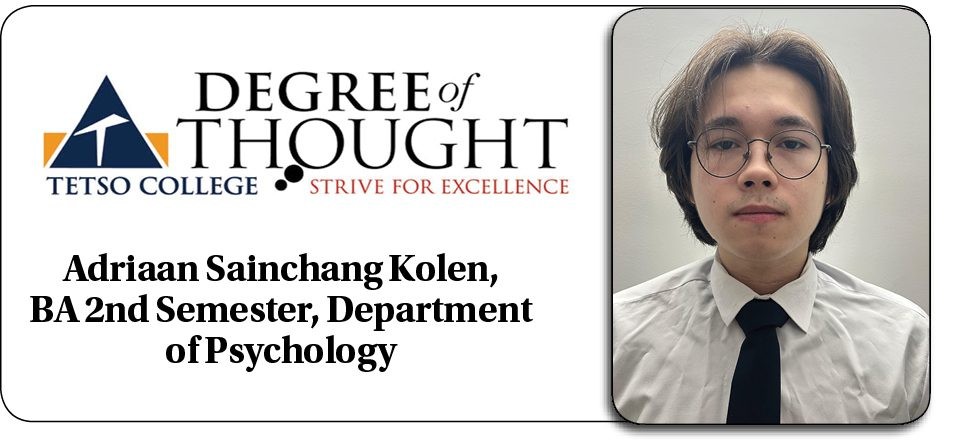
Degree of Thought is a weekly community column initiated by Tetso College in partnership with The Morung Express. Degree of Thought will delve into the social, cultural, political and educational issues around us. The views expressed here do not reflect the opinion of the institution. Tetso College is a NAAC Accredited UGC recognised Commerce and Arts College. The editorial team includes Chubamenla, Asst. Professor Dept. of English and Rinsit Sareo, Asst. Manager, IT, Media & Communications. For feedback or comments please email: [email protected]