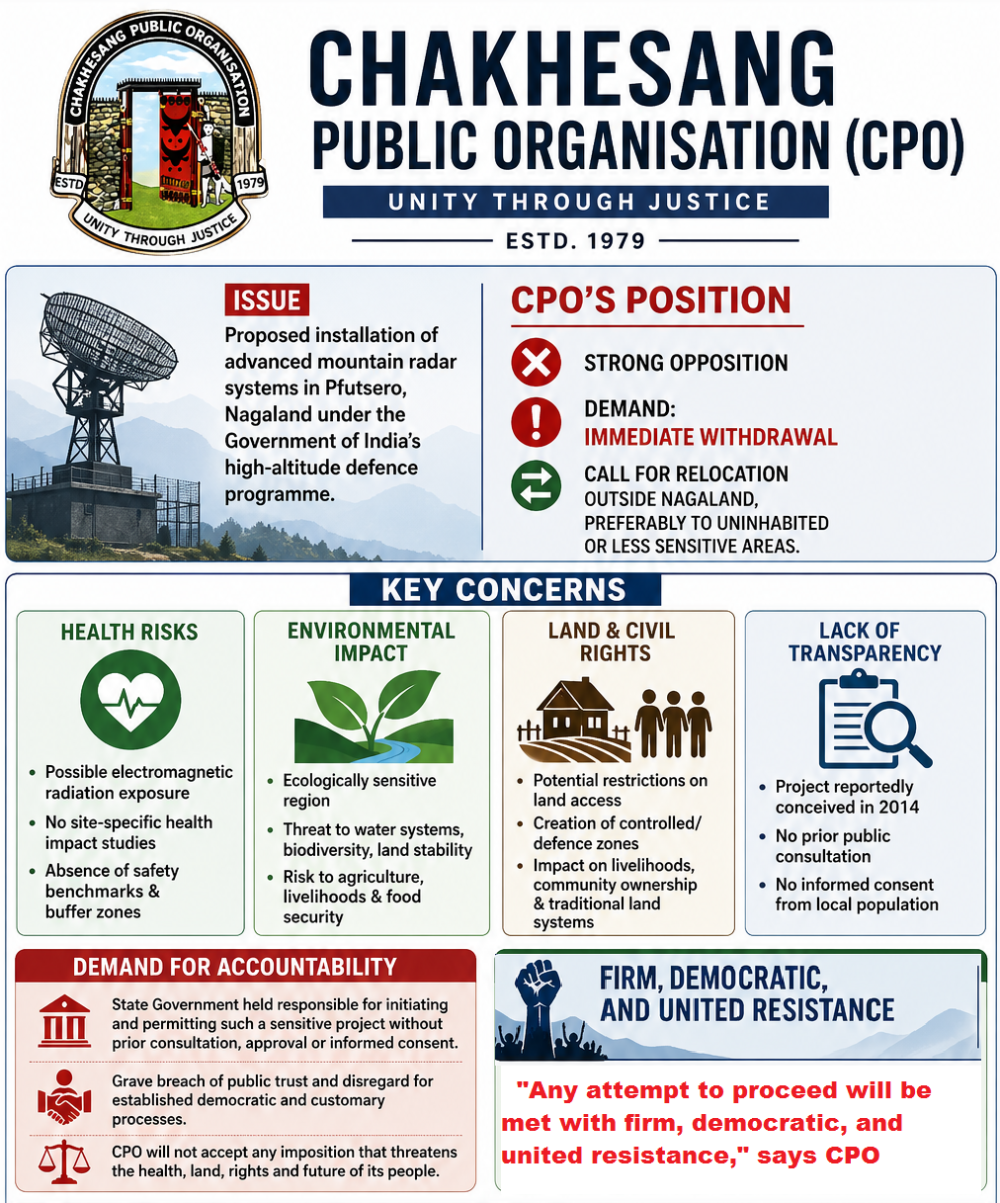
Phek, April 30 (MExN): The Chakhesang Public Organisation (CPO) has stated its categorical opposition to the proposed installation of advanced mountain radar systems in Pfutsero and demanded its immediate withdrawal.
It further called for the relocation of the proposed radar system, reportedly under the Government of India’s high-altitude defence programme, outside Nagaland, preferably to uninhabited or less sensitive areas.
In a press statement issued by CPO President Vezühü Keyho and General Secretary Chepetso Koza, several reasons were listed behind its opposition, asserting that any “attempt to proceed will be met with firm, democratic, and united resistance.”
Among others, the apex body representing the Chakhesang community pointed out that the “absence of transparent, location-specific safety studies and the lack of informed public consent render this project wholly unacceptable in any form.”
An initiative of such magnitude, with far-reaching implications for human health, land, and livelihoods, cannot be imposed without the knowledge, participation, and approval of the people directly affected, it asserted.
The CPO also stated that the proposed deployment of high-powered radar systems raises serious concerns regarding electromagnetic radiation exposure, particularly in a high-altitude and densely inhabited area like Pfutsero.
The absence of publicly available, site-specific health impact assessments, radiation benchmarks, and clearly defined safety buffer zones has only deepened public apprehension, it added.
Without credible and independently verified data, the local population cannot be expected to accept assurances at face value where long-term health risks may be involved, the CPO stated.
The organisation also maintained that Pfutsero and its surrounding areas are ecologically sensitive and agriculturally dependent, and any large-scale installation poses risks to catchment areas, natural water systems, biodiversity, and land stability.
Such disruptions would directly impact agriculture, livelihoods, and food security, which are intrinsically tied to the land and environment, it held.
Further, the CPO maintained that experiences from similar defence installations indicate that such infrastructure often leads to restrictions on land rights and civil liberties.
Limitations on access to residential and agricultural lands, the creation of controlled zones, and potential conflicts with authorities are unacceptable in a region where land is deeply tied to identity, inheritance, and community survival, it contended.
The CPO also flagged the apparent lack of transparency and state accountability, noting that a project reportedly conceived as far back as 2014 has remained largely undisclosed to the public.
In this connection, it “unequivocally” holds the State Government responsible for initiating and permitting the advancement of such a sensitive project without prior consultation, approval, or informed consent of the people.
This constitutes a grave breach of public trust and a disregard for established democratic and customary processes, it added.
Accordingly, the CPO called for an immediate halt to all plans for installation in Pfutsero and its relocation outside Nagaland.
It further stated that the Chakhesang community has always stood as proud patriots, upholding the “principles of peace, dignity, and self-determination.”
“From this conviction, it firmly rejects the imposition of defence installations within its jurisdiction,” it asserted, further reaffirming the enduring spirit and voice of the Naga people as expressed before the Simon Commission in 1929: “Leave us alone.”
The call continues to reflect the collective aspiration to live without external imposition on land, rights, and way of life, it added.