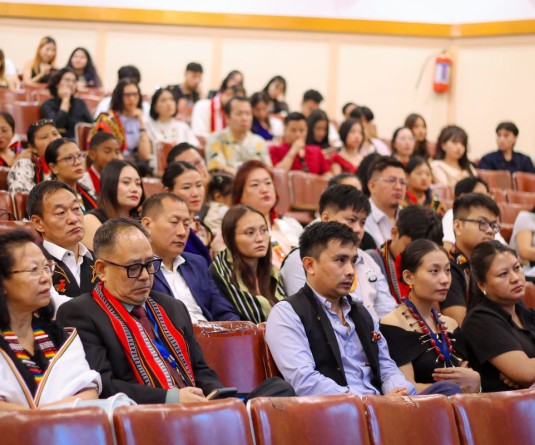
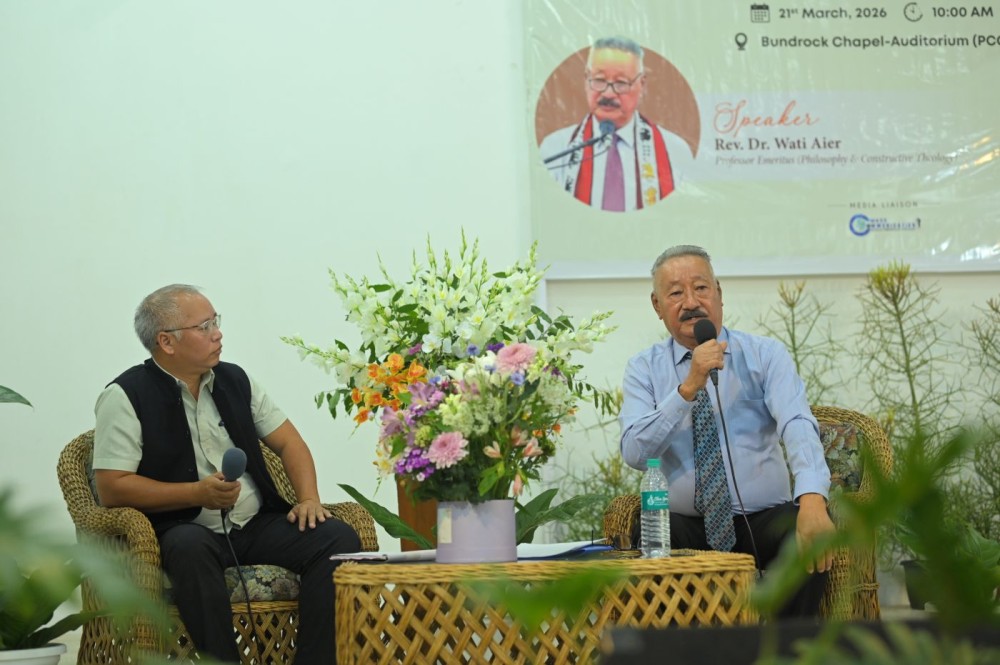
Rev Dr Wati Aier speaking at the Rev Dr Tuisem A Shishak Annual Lecture in Patkai Christian College, Chümoukedima on March 21.
Morung Express News
Chümoukedima | March 21
Leading peace and reconciliation crusader, Rev Dr Wati Aier, on Saturday, called for reimagining sovereignty beyond the conventional understanding and usage of the word, transcending political boundaries.
Speaking on the theme “The Trail & Trajectory of Naga Nationalism: Mapping the Way Forward” at the Rev Dr Tuisem A Shishak Annual Lecture in Patkai Christian College, Chümoukedima, Dr Aier advocated a shift in perception on ideas of Naga identity and nationalism. He called for embracing a more inclusive approach in which the complexities of identity and governance in a globalized world are recognized.
Dr Aier, convenor of Forum for Naga Reconciliation (FNR), acknowledged the divergent trajectories within the Naga political movement, driven by “internal conflicts of leadership, myth-making, and external forces of divide and rule,” had weakened the Naga cause, but the formation Council of Naga Cooperation and Relationship (CNCR) in 2025 signalled hope for the Naga people.
Dr Aier said that the CNCR—the Naga Machang, represents more than a political arrangement. “The Machang is a metaphor for relational sovereignty, where dialogue, mutual respect, and shared memory converge to shape a common destiny.”
“The trajectories of Naga nationalism point toward convergence, but the path is fraught with challenges,” the convenor noted, pointing out that the dialectical movement toward unity must be nurtured with patience, imagination, and courage. “The CNCR is a promising step, but it must be sustained by genuine dialogue and a commitment to dignity.”
“As people of a scholastic community,” he urged “to interrogate the narratives that have shaped Naga nationalism” adding, “Narrative-making has been both a source of inspiration and a cause of division.” He said, “A critical engagement with these narratives is necessary, not to dismiss them but to reinterpret them in ways that foster unity and authenticity.”
Naga nationalism stands at a crossroads, with trajectories pointing toward convergence amid persistent challenges, Dr Aier observed. Stressing the need for patience, imagination, and courage, he described the CNCR as a promising step that must be sustained through genuine dialogue and a commitment to dignity.
“The tension between Westphalian sovereignty and indigenous sovereignty must be creatively negotiated, not denied,” Dr Aier said, calling for a nationalism that is both indigenous and globally viable.
While acknowledging real divisions among factions, he maintained they are “not final,” pointing to a dialectical movement toward higher unity. The task, he added, requires not just political negotiation but theological imagination. “Nationalism without practice is empty, and practice without political articulation is ineffective.” He urged all Naga people to move forward “not as isolated factions but as a people united in dignity, authenticity, and hope.”
Meanwhile, the Annual Alumni Excellence Award was presented to Alobo Naga (Class of 2004) in recognition of his achievements in music and entertainment. It was given by Rev Dr T A Shishak, founder and principal emeritus of Patkai Christian College.