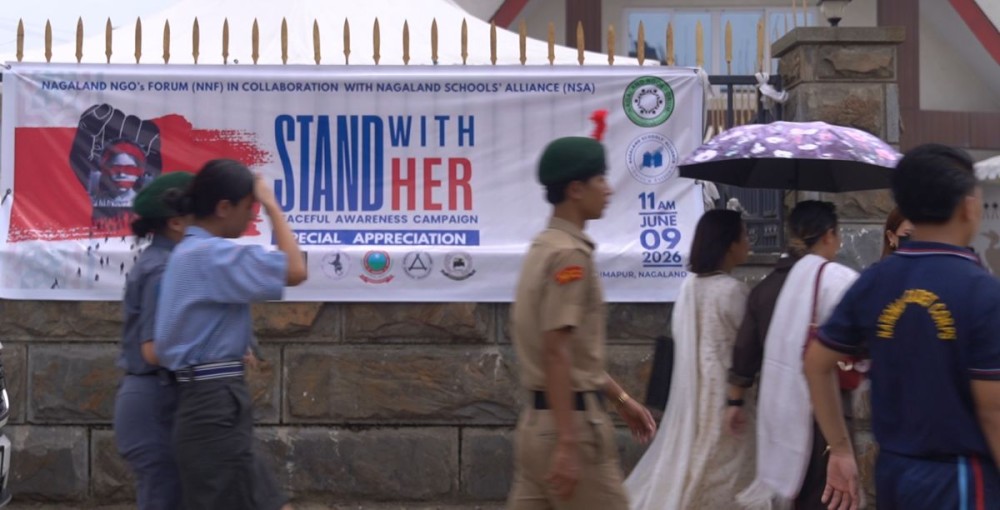
Students arriving to participate in the Stand With Her awareness campaign held at Town Hall, Dimapur on June 9. (Morung Photo)
Morung Express News
Dimapur | June 9
“Most of the time we think child abusers are a stranger from outside, but that is a wrong notion because child abusers are mostly from a safe haven, from a safe home,” said advocate and former Child Welfare Committee (CWC) member Limasenla Longkumer at the Stand With Her awareness campaign held at Town Hall, Dimapur on Tuesday.
The campaign, organised in solidarity with the 14-year-old victim of the recent reported rape case, was jointly organised by the Dimapur Eastern Nagaland Students’ Union (DENSU), Nagaland NGOs Forum (NNF) and the Nagaland Schools’ Alliance (NSA).
Drawing from her 15 years of work in the field of women and child rights, Longkumer said public perception often associates child abusers with strangers, whereas many cases involve relatives, guardians or other trusted individuals within the family circle.
Recalling an incident from around a decade ago, she said a judicial officer attending a gender sensitisation programme in Delhi had reported that Nagaland recorded zero cases of violence against women and children at the time, likely due to widespread underreporting. She described this as a paradox in light of present realities.
Speaking on child protection mechanisms, Longkumer said children in need of care and protection come under the purview of the Child Welfare Committee, a quasi-judicial body. Referring to the ongoing case, she noted that support persons are appointed to assist child victims and help them navigate the process in a child-friendly manner.
She also challenged the belief that children frequently fabricate allegations. Based on her experience handling cases, Longkumer said children may conceal or distort facts for a short period but they cannot lie for a long time.
The former CWC member said child protection officials often face resistance while handling abuse cases, when the accused belong to influential, educated or financially secure families. Such pressures, she said, can make the work of CWC members and other child protection authorities particularly challenging.
On victim compensation, Longkumer said financial assistance available to survivors of violence is often misunderstood by the public. She clarified that compensation is intended to support rehabilitation, medical care and reintegration into society rather than serving as a payment for the crime committed against the victim.
She also raised concern over attempts to settle abuse cases through compromise, asserting that society must move away from such practices.
Addressing leaders and representatives of various organisations present at the programme, Longkumer urged that appointments to child and women protection institutions be based on expertise and experience rather than nepotism or political considerations.
“When appointing members of such sensitive protection systems, let’s not appoint with nepotism. No political appointees. Appoint those who are experts in that field, who have experience,” she stated.
‘Injustice begins at police station’
Echoing concerns over the challenges faced by victims seeking justice, Esther K Aye, Legal Advisor, Nagaland Alliance for Women and Child Rights, said legal safeguards already exist under the Protection of Children from Sexual Offences (POCSO) Act, but implementation remains a major concern.
Having worked with women and children for nearly 15 years, she said, “Sometimes we feel very discouraged, we want to give up, but seeing so much injustice, we cannot.”
Aye noted that the state has designated special courts, special judges and special public prosecutors to handle POCSO cases in a child-friendly manner. However, she argued that despite these safeguards, victims are often failed by the very system meant to protect them.
“We can’t just blame only the abuser. There is a problem with the system itself,” she said.
Referring to the provisions of the POCSO Act, Aye said the Act is very clear. Matters relating to sexual assault of minors are mandatory to be reported, it is mandatory to lodge an FIR. “But when there is a delay of lodging an FIR in the police station, the injustice begins from the police station itself because it is the place where justice for the child starts,” she stated.
Questioning societal attitudes towards victims, Aye said she often finds that support tends to shift towards the accused once a case is registered.
“I really don’t understand why the society and the system is more protective of the accused rather than being supportive to the victim. Suddenly a case is registered, everyone becomes a friend of the accused, but there is no one for the victim,” she said. Drawing from cases handled by her organisation, she recounted instances where victims and their families faced immense pressure to withdraw complaints, including cases involving influential individuals and institutions.
Referring to one such case, she said a minor child who was allegedly abused by the proprietor of an institution faced tremendous pressure after the matter came to light.
She spoke of another case involving the alleged rape of a minor by her biological father. According to Aye, the child continued to live in fear because the accused had not been arrested.
“Just imagine the trauma that the child goes through. That is what happens when the system fails them,” she said.
In another case, she said a widow and her family were allegedly threatened with excommunication from their village unless they withdrew a rape case against a person from an influential family. The pressure became so severe that the support person assisting the victim reportedly fell into depression.
Clarifying a common misconception surrounding child sexual abuse laws, Aye said the POCSO Act is gender neutral and protects all children below 18 years of age, irrespective of gender.
Highlighting that such abuse affects boys as well as girls, she referred to a case involving six minor boys who were allegedly abused by a pastor and are still awaiting justice.
“We don’t just have one minor child, a 14-year-old girl, but we also have another six minor boys who are still awaiting justice. Please do not forget them,” she appealed.
She said two of the boys had already dropped out of school because of the trauma they experienced. Aye also called on the state government to establish an emergency fund for child victims, noting that compensation schemes often take time because of procedural requirements.
“When we face this kind of situation, we do need an emergency fund,” she said, pressing the government to create a separate budget allocation for children.