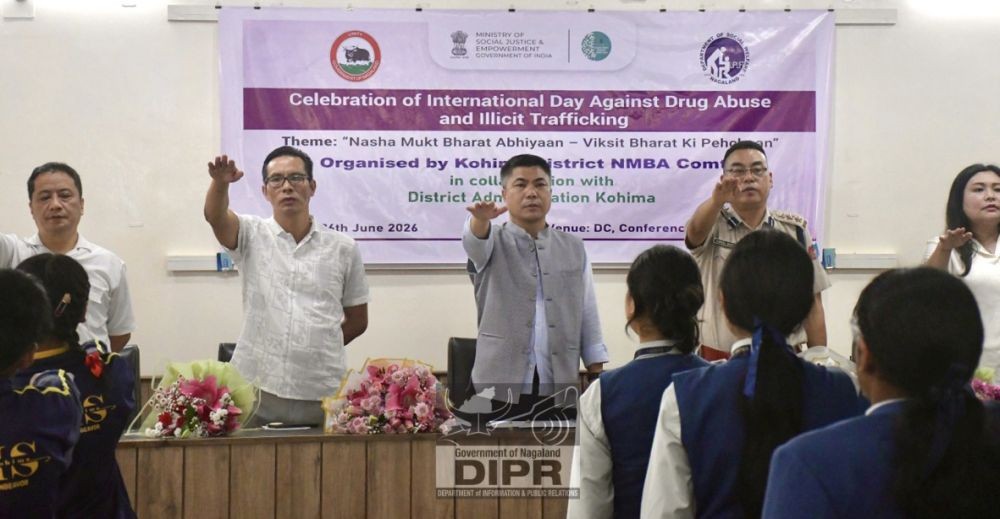
Participants take the anti-drug pledge during the observance of the International Day Against Drug Abuse and Illicit Trafficking at the DC's Conference Hall, Kohima, on June 26. (DIPR Photo)
DIMAPUR, JUNE 26 (MExN): The International Day Against Drug Abuse and Illicit Trafficking was observed across Nagaland on June 26 with rallies, awareness programmes, pledges and community campaigns, as government departments, law enforcement agencies, civil society organisations, churches and youth groups renewed calls for collective action against substance abuse under the Nasha Mukt Bharat Abhiyan.
In Kohima, the District Nasha Mukt Bharat Abhiyan (NMBA) Committee, in collaboration with the District Administration, organised a programme at the Deputy Commissioner's Conference Hall under the theme "Nasha Mukt Bharat Abhiyaan, Viksit Bharat Ki Pehchaan."
Deputy Commissioner B. Henok Buchem said young people are the strongest agents of positive social change and urged them to become ambassadors against substance abuse. Recalling visits to the district jail, he said it was painful to see many young people imprisoned because of drug abuse and trafficking, adding that addiction often begins with seemingly harmless habits before progressing to more dangerous substances.
"The response should not be limited to punishing offenders but should also focus on prevention, treatment, rehabilitation and strong community support," he said, while urging all stakeholders to work together to build healthier families and safer communities.
Senior Superintendent of Police Krodi Rhetso described awareness as the most effective weapon against drug abuse and said the participation of students, police personnel, government officials and the public in a mini marathon earlier in the day reflected a shared commitment to a drug-free society. He informed that during the past one-and-a-half years, Kohima Police had seized about 7.9 kg of heroin, 9.4 kg of brown sugar, 20.9 kg of opium, 238 bottles of cough syrup, around 400 strips of Nitrazepam tablets and more than 200 strips of Tramadol tablets while registering over 33 cases under the NDPS Act. He stressed that policing alone could not solve the problem and called for the support of parents, teachers, churches and community leaders.
Director of Life Connect Nagaland, Sali Kez Ngully, described addiction as a public health issue rather than a moral failing and said recovery requires treatment, compassion and sustained community support. She highlighted the organisation's work in helping women recover from addiction through counselling, rehabilitation, livelihood training and support for children of women undergoing treatment. She also proposed greater government collaboration, livelihood opportunities and a dedicated residential rehabilitation and vocational training centre for women in recovery. A woman recovering from alcohol addiction shared her testimony during the programme, while the Deputy Commissioner also released an awareness video titled "Voice of Hope."
In Noklak, the observance was held at White Hall under the theme "World Drug Problem: Persisting Issues, New Challenges, Innovative Responses." EAC Apuloka H. Sumi said drug abuse affects not only individuals but also families and society, urging everyone to "say no to drugs" and renew their commitment to combating substance abuse.
Cluster Prevention Officer of NSACS, Chubainla Longchar, said stigma and discrimination against drug users remain widespread and appealed to the public to support those struggling with addiction instead of isolating them. Counsellor Onokesenu Kera of the OST Centre at District Hospital Noklak said drug abuse is a global challenge but emphasised that recovery is possible with proper support. Representatives from the Social Welfare Department, Thang Range Public Organisation and Khiamniungan Menyiu Hoikam also expressed concern over the growing drug problem in the district and called for united community action. A recovering addict shared how OST services had helped him overcome addiction.
In Tseminyu, the District Administration and Department of Social Welfare, in collaboration with the Tseminyu Village Youth Organisation, organised a rally from Tseminyu Village to the Town Hall as part of the culmination of Nasha Mukti Sapta. Deputy Commissioner Japheth Woch called on not only youth organisations but all civil society organisations to take a firm stand against substance abuse. The programme also included a session on stress management, peer pressure and substance abuse, followed by a mass signature campaign reaffirming the community's commitment to a drug-free district.
At Mon, the observance was held at the Town Council Hall. Superintendent of Police Kanchan Kumar Kanpal urged people to spread awareness about the dangers of drug abuse, saying self-awareness serves as a protective barrier against addiction. He appealed to the public to cooperate with the police, stating that "together we can eradicate drugs from our society."
Medical Officer Dr Tingthong said drug abuse has become a significant concern in Mon district, identifying opium, ganja, sunflower and black-market OST drugs among the substances commonly abused. He also briefed participants on the services available at OST centres in District Hospital Mon, CHC Aboi and PHC Tizit. Representatives of the Konyak Union and Konyak Students' Union also addressed the gathering.
In Pungro, the Yimkhiung Youth Organisation, in collaboration with the District Administration, Nagaland Police, Nagaland Village Guard, 30 Assam Rifles, Achomang MPCS TI-Pungro and civil society organisations, organised a public programme and rally under the theme "World Drug Problems: Persisting Issues, New Challenges, Innovative Responses." Speakers from government agencies, security forces and community organisations highlighted the health and social consequences of drug abuse and stressed the need for continued efforts against illicit trafficking. The programme concluded with a rally from the Traffic Point to Six Star Junction.
At Mokokchung, the culmination of the week-long Nasha Mukt Bharat Saptah was held at the Deputy Commissioner's Conference Hall. Deputy Commissioner Ajit Kumar Verma said the Nasha Mukt Bharat Abhiyan is an important pillar of Viksit Bharat and stressed that both supply and demand must be addressed in tackling the drug problem. He said awareness and rehabilitation are essential and urged churches and social institutions to actively support rehabilitation efforts.
Senior Superintendent of Police Vesupra Kezo highlighted the impact of drugs on individuals, families and law and order, saying awareness remains the key to combating the menace. The programme also featured talks on treatment options, youth participation in building a drug-free society, prize distribution and a collective drug-free pledge.